


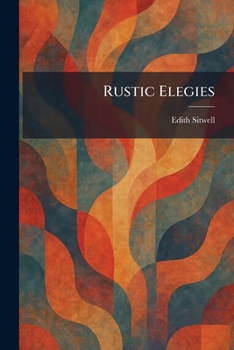
Rustic Elegies

Select Format
Select Condition 
Book Overview
"Rustic Elegies" is a profound and evocative collection of modernist poetry by Edith Sitwell, one of the most distinctive voices of the early twentieth century. This volume showcases Sitwell's unique ability to blend intricate rhythms with vivid, often surreal imagery to explore themes of loss, memory, and the transience of beauty. The collection features some of her most celebrated early works, including the ambitious "Elegy on Dead Fashion," "The Little Ghost who Died for Love," and the poignant "The Hambone and the Heart."
Through these verses, Sitwell navigates the delicate boundary between the natural world and the artifice of human society, often reflecting on the decay of the past and the spectral presence of things left behind. Her linguistic precision and experimental approach to sound and meter create a haunting atmosphere that remains central to the legacy of British modernism. "Rustic Elegies" captures a pivotal moment in Sitwell's career, demonstrating her mastery of the elegiac form while pushing the boundaries of traditional verse. This collection is essential for readers interested in the evolution of twentieth-century poetry and the development of Sitwell's rhythmic and symbolic style.
This work has been selected by scholars as being culturally important, and is part of the knowledge base of civilization as we know it. This work was reproduced from the original artifact, and remains as true to the original work as possible. Therefore, you may see the original copyright references, library stamps (as most of these works have been housed in our most important libraries around the world), and other notations in the work.
This work is in the public domain in the United States of America, and possibly other nations. Within the United States, you may freely copy and distribute this work, as no entity (individual or corporate) has a copyright on the body of the work.
As a reproduction of a historical artifact, this work may contain missing or blurred pages, poor pictures, errant marks, etc. Scholars believe, and we concur, that this work is important enough to be preserved, reproduced, and made generally available to the public. We appreciate your support of the preservation process, and thank you for being an important part of keeping this knowledge alive and relevant.
Customer Reviews
ThriftBooks ® and the ThriftBooks ® logo are registered trademarks of Thrift Books Global, LLC
