


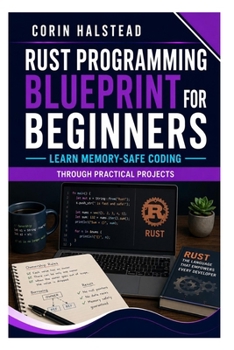
Rust Programming Blueprint for Beginners: Learn Memory-Safe Coding Through Practical Projects

Build real Rust programs while learning the concepts that make Rust powerful, safe, and practical.
Rust Programming Blueprint for Beginners is a hands-on guide for learning Rust through clear explanations, disciplined coding habits, and progressively more realistic projects. Instead of memorizing syntax in isolation, you will learn how Rust works by building programs that solve practical problems.
No previous Rust or systems-programming experience is required.
You will begin by setting up the Rust toolchain and learning a professional Cargo-based workflow. From there, each chapter introduces new language features while showing how they affect real program design.
Inside, you will learn how to:
Work confidently with variables, types, functions, control flow, structs, enums, collections, and pattern matchingUnderstand ownership, moves, borrowing, references, slices, lifetimes, and memory-safe designUse vectors, hash maps, strings, iterators, closures, generics, traits, and smart pointersHandle recoverable failures with Result and optional values with OptionOrganize larger applications with packages, crates, modules, documentation, and clear interfacesWrite unit and integration tests and use compiler diagnostics as part of the development processBuild safe concurrent programs using threads, channels, Arc, Mutex, Send, and SyncWork with command-line arguments, paths, files, input, output, and file-processing pipelinesStructure programs so domain logic, storage, error handling, and presentation remain maintainableAlong the way, you will build practical projects including a measurement converter, score analyzer, text inspector, task-state model, word-frequency analyzer, reusable reporting library, configuration loader, event dispatcher, parallel batch processor, and file-based inventory reporter.
The final capstone brings everything together in a memory-safe inventory manager with structured domain types, persistent storage, validation, error handling, modules, tests, searching, reporting, and clearly defined ownership boundaries.
Whether you are learning your first serious programming language, moving from Python, JavaScript, Java, C#, PHP, C, or C++, changing careers, studying software development, or adding Rust to your professional toolkit, this book gives you a structured path from your first Cargo project to independently designed Rust applications.
Customer Reviews
ThriftBooks ® and the ThriftBooks ® logo are registered trademarks of Thrift Books Global, LLC
