


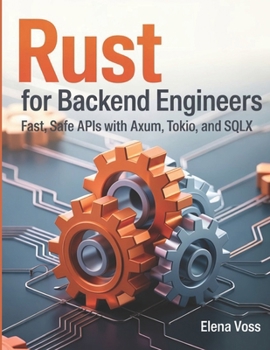
Rust for Backend Engineers: Fast, Safe APIs with Axum, Tokio, and SQLx

You have read the blog posts. You know Rust is fast and that the borrow checker catches the bugs that wake other teams up at 3 AM. The question sitting on your desk is different: what does it actually look like to ship a backend service in Rust? Not a tutorial. Not a demo. The real thing - the kind of code that runs for years and survives schema migrations, on-call rotations, and the engineer who joins next quarter and has to read it.
This book answers that question, end to end.
Every chapter is grounded in production decisions a working engineer actually faces, not toy examples that fall apart under load. It walks from your first cargo new through async fundamentals, builds an HTTP service with Axum, talks to Postgres through SQLx, and closes with the operational discipline that keeps services healthy at scale.
You will learn how ownership feels day to day, why async Rust requires you to think about cancellation, what tower:: Service really does under your handlers, and how compile-time query verification with SQLx catches the SQL typos other languages let you ship. You will see how to model authentication that does not break on the first edge case, how to write tests that run in milliseconds without a database, how to ship Docker images under 30 megabytes, and how to instrument a service so the engineer on call at 3 AM has what they need.
Inside, you will find:
A foundation in Rust that is honest about ownership, lifetimes, and error handling. No glossing, no apologies. The mental model that makes the compiler your collaborator instead of your adversary.A practical tour of Tokio: the runtime, channels, cancellation, backpressure, and the subtle bugs that show up when you hold a lock across an .await.Axum from the inside out. Routing, extractors, state, middleware as Tower layers, sessions and JWTs, validation that fails loudly at the boundary.SQLx with real-world rigor: pool sizing, transactions, migrations that survive rolling deploys, repository patterns that keep SQL out of handlers.Production concerns most books skip. Structured logging with tracing, distributed tracing with OpenTelemetry, metrics with bounded cardinality, profiling with flamegraphs and tokio-console.Deployment: multi-stage Docker builds, distroless and musl images, graceful shutdown, liveness probes that do not cause restart storms.Background jobs that survive a process crash. Postgres queues with FOR UPDATE SKIP LOCKED, idempotency, WebSockets, server-sent events.This is not a book for someone who wants to be told Rust is the best language. It is a book for someone who has decided to use Rust and wants to do it well. It assumes you can program. It does not assume you have written a line of Rust, but if you have, you will move quickly through the early chapters and find the production material is where the real work is.
The voice is plain. The patterns have survived contact with on-call rotations, customer escalations, and the hardest critic of all - the engineer who has to read your code six months from now. Where there are tradeoffs, you get them, not the marketing version. Where there are mistakes that have cost real money in real services, you get those too.
If you are evaluating Rust for a service you are about to start, this book will tell you what you are signing up for. If you are mid-project and the patterns are not clicking, this book will give you patterns that hold up. If you are already running Rust in production and the codebase is starting to show its age, this book will help you understand where to tighten, where to simplify, and where to rebuild.
If you want to ship Rust services with more confidence, fewer surprises, and architecture that still makes sense a year from now, this book will help you build that foundation.
Customer Reviews
ThriftBooks ® and the ThriftBooks ® logo are registered trademarks of Thrift Books Global, LLC
