


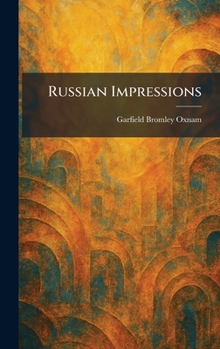
Russian Impressions

"Russian Impressions" is a detailed and insightful travel narrative that explores the social, political, and cultural landscape of the Soviet Union during the late 1920s. Written by G. Bromley Oxnam, the work provides a firsthand account of a nation in the throes of radical transformation following the Russian Revolution. Through a series of keen observations, the author examines the daily realities of the Russian people, the implementation of Soviet policies, and the pervasive influence of revolutionary ideology on the traditional structures of society.
The text delves into critical themes such as the state of religion, the reform of the education system, and the industrial progress of the early USSR. By documenting his journey through various regions and interactions with local citizens, Oxnam offers a unique Western perspective on the successes and failures of the Bolshevik experiment. "Russian Impressions" remains a significant historical document for those seeking to understand the complexities of early 20th-century international relations and the human dimensions of a society undergoing profound systemic change. The work is particularly valuable for its focus on the intersection of faith, social justice, and political theory during a formative period of modern history.
This work has been selected by scholars as being culturally important, and is part of the knowledge base of civilization as we know it. This work was reproduced from the original artifact, and remains as true to the original work as possible. Therefore, you may see the original copyright references, library stamps (as most of these works have been housed in our most important libraries around the world), and other notations in the work.
This work is in the public domain in the United States of America, and possibly other nations. Within the United States, you may freely copy and distribute this work, as no entity (individual or corporate) has a copyright on the body of the work.
As a reproduction of a historical artifact, this work may contain missing or blurred pages, poor pictures, errant marks, etc. Scholars believe, and we concur, that this work is important enough to be preserved, reproduced, and made generally available to the public. We appreciate your support of the preservation process, and thank you for being an important part of keeping this knowledge alive and relevant.
Customer Reviews
ThriftBooks ® and the ThriftBooks ® logo are registered trademarks of Thrift Books Global, LLC
