


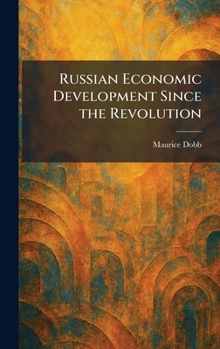
Russian Economic Development Since the Revolution

"Russian Economic Development Since the Revolution" provides a rigorous and detailed analysis of the economic transformations within the Soviet Union following the 1917 Bolshevik Revolution. Authored by the prominent economist Maurice Dobb, this work examines the transition from a traditional agrarian society to a state-controlled industrial power. The text explores the implementation of early Soviet economic policies, the challenges of the New Economic Policy (NEP), and the initial steps toward centralized planning and large-scale industrialization.
Dobb provides critical insight into the structural changes in industry and agriculture, the evolution of labor relations, and the financial mechanisms that underpinned the early Soviet state. This study is an essential resource for understanding the complex interplay between political ideology and economic reality in the first decade of the USSR. It remains a foundational text for scholars of economic history, political science, and Russian studies, offering a contemporary perspective on one of the most significant socio-economic experiments of the twentieth century.
This work has been selected by scholars as being culturally important, and is part of the knowledge base of civilization as we know it. This work was reproduced from the original artifact, and remains as true to the original work as possible. Therefore, you may see the original copyright references, library stamps (as most of these works have been housed in our most important libraries around the world), and other notations in the work.
This work is in the public domain in the United States of America, and possibly other nations. Within the United States, you may freely copy and distribute this work, as no entity (individual or corporate) has a copyright on the body of the work.
As a reproduction of a historical artifact, this work may contain missing or blurred pages, poor pictures, errant marks, etc. Scholars believe, and we concur, that this work is important enough to be preserved, reproduced, and made generally available to the public. We appreciate your support of the preservation process, and thank you for being an important part of keeping this knowledge alive and relevant.
Related Subjects
Business Business & Investing Political Science Politics & Social Sciences ReferenceCustomer Reviews
ThriftBooks ® and the ThriftBooks ® logo are registered trademarks of Thrift Books Global, LLC
