


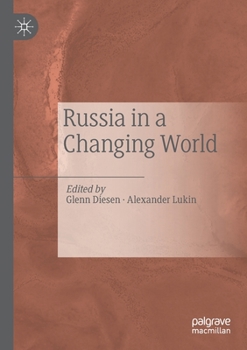
Russia in a Changing World

Select Format
Select Condition 
Book Overview
Chapter 1: Russia's Foreign Policy Responding to Global Changes
Sergey Karaganov
Sergey Karaganov, the Dean of the Faculty of World Economy and International Affairs at HSE and Honorary Chairman of the CFDP, deliberates on an evolving Russian foreign policy that has responded to global and regional changes over the past decades. Karaganov is a staunch advocate for Russia to align itself with China, India, Iran and other non-Western powers to construct a constrained multipolar world. The pivot to Asia is intended to also restructure Moscow's relationship with the West. Russia should prevent a further drift towards a major war among great powers by using its new Eurasian position to mitigate tensions with the West rather than intensify existing conflicts.
Chapter 2: Moving Beyond the Failed New World Order
Fyodor Lukyanov
Fyodor Lukyanov, the editor of the influential journal Russia in Global Affairs and Chairman of the Presidium of the CFDP, posits that a stable international order never established itself after the Cold War - defined as a shared commitment to status quo of the basic rules and organisation of the international system. The post-Cold War world order was intended to transition into a system where the world was no longer divided because of their support for either the US or Soviet Union, and instead come together to resolve the most pressing problems of the world. The Western-centric world order failed as the imperative of preserving the unipolar distribution of power undermined the ability to address and solve the world's problems. While the unipolar world is coming to an end, a multipolar system has yet emerged. There is a multipolar distribution of power, yet the unilateralism of the unipolar era still prevails. Lukyanov posits that due to its size, geopolitical location, resource potential, great power tradition, and aspirations - Russia finds itself in the middle of the most important trends shaping the next world order. Global demand for a stable and balanced model is intertwined with Russia's quest for its new international identity. Reassessment of the past quarter of a century is needed in Russia both internationally and nationally to pave a way to the future.
Chapter 3: Russia's Pivot to Asia
Alexander Lukin
Alexander Lukin, the Department Head, Faculty of World Economy and International Affairs at HSE and Director of the Center for East Asian and SCO Studies at Moscow State Institute of International Relations of the Russian Ministry of Foreign Affairs, explores Russia's pivot to Asia. While Russia's pivot to Asia has its successes and setbacks, the pivot is a reality that appears to be 'irreversible'. Supported by both economic and political strategic interests, Russia has made formidable investments to rewire global value chains by linking itself to the Asian giants. With a growing number of states across the massive continent embracing some format for Eurasian integration, Russia is finding partners to enhance economic connectivity and develop new political realities. The growing sentiment among the Russian political class and society is that the West has less to offer and new opportunities await in Asia. Yet, a formidable struggle awaits as Russia is less experienced in the political, economic and security environment of Asia and nobody is waiting for them with open arms.
Chapter 4: Russia's Economic Restructuring
Leonid Grigoryev
Leonid Grigoryev, tenured professor at HSE and Russia's former deputy minister of economics and finances, argues that the Russian economy has continued it historical dependence on export of raw material exports. Russia's energy curse has been defined by de-industrialisation as energy exports became Russia's comparative advantage in the free market. The energy curseCustomer Reviews
ThriftBooks ® and the ThriftBooks ® logo are registered trademarks of Thrift Books Global, LLC
