


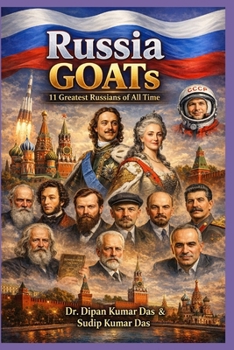
Russia GOATs: 11 Greatest Russians of All Time

Steel in posture. Storm in vision.
Peter stands not merely as a ruler but as a tectonic shift in human form. Military coat pressed like a manifesto, boots planted as if Russia itself were rising beneath them. He dragged a medieval state toward modernity with shipyards, cannons, and a stubborn will that refused to blink.
He built St. Petersburg like a window carved into ice. Through it, Russia inhaled Europe.
An emperor who did not inherit greatness quietly. He engineered it.
Velvet authority. A mind sharper than any jeweled crown.
Catherine's regal presence filled rooms long before she entered them. Draped in imperial silk, posture steady as marble columns, she expanded Russia's borders and its intellectual appetite.
Under her reign, art flourished, education grew, and palaces whispered Enlightenment ideas in candlelight. She ruled not as ornament, but as architect of empire.
3. Leo TolstoyA beard like winter. Eyes that had read the human soul.
Tolstoy did not simply write novels. He excavated humanity. War and Peace is not a book; it is a continent. Anna Karenina does not unfold; it breathes.
An aristocrat who questioned wealth. A literary giant who wrestled with morality like a prophet in peasant clothes.
4. Fyodor DostoevskyEyes like interrogation lamps.
Dostoevsky did not describe characters. He put them on trial. Guilt, faith, despair, redemption, all collided in his pages. Crime and Punishment reads like a confession whispered in a dark room.
His 19th-century silhouette hides a mind centuries ahead. Psychological fiction bows to him.
5. Alexander PushkinThe gentleman poet. Russia's lyrical heartbeat.
Pushkin's elegant attire matched the elegance of his verse. He gave Russian language its musical spine. Romantic, rebellious, refined.
If Russian literature were a cathedral, Pushkin laid the foundation stones.
6. Vladimir LeninBald head. Razor focus.
Lenin's stern expression mirrors the seismic shift he led. The 1917 Revolution was not a tremor; it was an earthquake that redrew maps and ideologies.
He did not merely lead a movement. He reshaped a century.
7. Pyotr Ilyich TchaikovskyRefinement in every note.
Tchaikovsky composed like someone translating emotion into orchestral weather. Swan Lake, The Nutcracker, symphonies that shimmer between melancholy and magnificence.
His composer-era elegance conceals storms of feeling beneath tailored restraint.
8. Yuri GagarinA helmet reflecting Earth.
Gagarin's smile carried the weight of a planet. In 1961, he orbited Earth and expanded humanity's ceiling. The cosmos suddenly felt closer.
His face inside that cosmonaut helmet became a symbol of daring curiosity.
9. Joseph StalinA mustache that history cannot ignore.
Stalin industrialized the Soviet Union at staggering human cost. His rule hardened the nation through fear, war, and ruthless consolidation of power.
Controversial, formidable, undeniable in impact.
10. Dmitri MendeleevThe architect of elements.
Mendeleev looked at chaos in chemistry and saw a pattern waiting to be arranged. The periodic table stands like intellectual architecture, each element finding its seat.
Order from atomic anarchy.
11. Garry KasparovA battlefield of sixty-four squares.
Kasparov turned chess into high-voltage drama. Precision, aggression, strategic poetry. He did not just win games; he redefined competitive intellect.
On that checkered universe, he reigned like a monarch of calculation.
Customer Reviews
ThriftBooks® and the ThriftBooks® logo are registered trademarks of Thrift Books Global, LLC
