


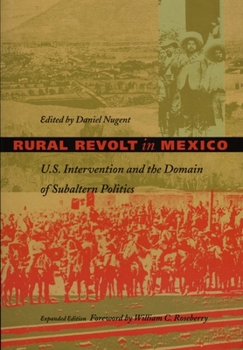
Rural Revolt in Mexico: U.S. Intervention and the Domain of Subaltern Politics


Select Format
Select Condition 
Book Overview
Rural Revolt in Mexico is a historical investigation of how subaltern political activity engages imperialism, capitalism, and the United States. In this volume, Daniel Nugent has gathered a group of leading scholars whose work examines the relationship of revolts by peasants and Indians in Mexico to the past century of U.S. intervention-from the rural rebellions of the 1840s through the 1910 revolution to the 1994 uprising in Chiapas.
Through their studies of social movements and popular mobilization in the Mexican countryside, the contributors argue for understanding rural revolts in terms of the specific historical contexts of particular regions and peoples, as well as the broader context of unequal cultural, political, and economic relations between Mexico and the United States. Exploring the connections between external and internal factors in social movements, these essays reveal the wide range of organized efforts through which peasants and Indians have struggled to shape their own destiny while confronted by the influence of U.S. capital and military might. Originally published as a limited edition in 1988 by the Center for U. S.-Mexican Studies, this volume presents a pioneering effort by Latin Americanist scholars to sympathetically embrace and enrich work begun in Subaltern Studies between 1982 and 1987 by projecting it onto a different region of historical experience. This revised and expanded edition includes a new introduction by Daniel Nugent and an extensive essay by Adolfo Gilly on the recent Chiapas uprising.
Through their studies of social movements and popular mobilization in the Mexican countryside, the contributors argue for understanding rural revolts in terms of the specific historical contexts of particular regions and peoples, as well as the broader context of unequal cultural, political, and economic relations between Mexico and the United States. Exploring the connections between external and internal factors in social movements, these essays reveal the wide range of organized efforts through which peasants and Indians have struggled to shape their own destiny while confronted by the influence of U.S. capital and military might. Originally published as a limited edition in 1988 by the Center for U. S.-Mexican Studies, this volume presents a pioneering effort by Latin Americanist scholars to sympathetically embrace and enrich work begun in Subaltern Studies between 1982 and 1987 by projecting it onto a different region of historical experience. This revised and expanded edition includes a new introduction by Daniel Nugent and an extensive essay by Adolfo Gilly on the recent Chiapas uprising.
Format:Paperback
Language:English
ISBN:0822321130
ISBN13:9780822321132
Release Date:June 1998
Publisher:Duke University Press
Length:408 Pages
Weight:1.58 lbs.
Dimensions:1.2" x 6.1" x 9.1"
Customer Reviews
2 ratings
a book that sees the Revolution from a new angle
Published by Thriftbooks.com User , 24 years ago
This book is a collection of essays written in the mid-1980's by a group of dedicated scholars who spend countless hours interviewing participants in the Mexican Revolution and reviewing archives. It focuses on the Revolution from a grassroots basis, and I think that the work of some of these authors has been responsible for the shift of emphasis from a national sort of scenario to the that which is based on the concept of the "patria chica", which was the actual operating model in the perceptions of the majority of participants.Among the giants of Revolution scholarship who participated in the development of this book is Friedrich Katz, whose mammoth work, The Life and Times of Pancho Villa is, for all effects and purposes, the definitive work on the subject, EXCEPT that within THIS work, one can see right away that his very contemporaries who were working almost side by side with him at the time of his own research reached some different conclusions and covered some very important material that he both overlooked and failed to see the importance of. This statement particularly applies to the essay by Maria Teresa Koreck, "Space and Revolution in Northeastern Chihuahua", which defines the concept of the "patria chica" and very conclusively proves, in my opinion, that this was the motivating force in the revolutionary soldiers and cadres themselves. One can see from this essay that the troops of Villa, who were descended from Apache fighters and a generation before the arrival of the militarized colonists in the mid-19th century, from a rather `indianized' population, saw him as something like a great Indian war chief - sort of a Geronimo for the "patria chica".Another essay that very much caught my attention was that of Ruben Osorio, entitled "Villismo: Nationalism and Popular Mobilization in Northern Mexico", which I think influenced Katz quite a bit, as Osorio and Katz collaborated a lot. In this essay, the roots of the Revolution in Mexico are made quite clear, and the long buildup of hostilities between the militarized villagers who had fought the Apache wars and the oligarchic families such as the Terrazas are made clear, with a number of regional conflicts that predated the Revolution brought into focus. Osorio states that, for all effects and purposes, the Revolution began with the rebellion in Tomochic, and it didn't end until the surrender of Villa in 1920. It was, then, a series of regional and sometimes isolated conflicts lasting some 30 years, with the common thread being the defense of the `patria chica' from the encroachment of hacendados and latifundistas.Organizers like Flores Magon and Madero entered almost as interlopers in conflicts that had been ongoing, and were not about to subside with their exit from the scene. Leaders like Villa really didn't need any ideology to lead these fighters. It was enough that they were seen as the natural leaders for tribal societies.Another important aspect that one sees, particularly in the e
Essays bring peasants to the forefront
Published by Thriftbooks.com User , 26 years ago
This collection enriches a growing body of scholarship that focuses on the roles played (or sometimes not played) by subaltern peoples (i.e. peasants, workers...)in the making of modern Latin America. Focusing on Mexico, this volume contains spirited debates on peasant nationalism and, as its title suggests, on the conspicuous and inconspicuous power of US capital and policy during the Porfiriato (1876-1911)and the opening scenes of the Revolution (1911-?). Its main problem lies not in content or structure, but in delivery. Needless jargon permeates this volume, and, unfortunately, shuts out a great many readers.
Copyright © 2026 Thriftbooks.com Terms of Use
| Privacy Policy | Do Not
Sell/Share My Personal Information | Cookie Policy | Cookie Preferences | Accessibility Statement
ThriftBooks® and the ThriftBooks® logo are registered trademarks of Thrift Books Global, LLC
ThriftBooks® and the ThriftBooks® logo are registered trademarks of Thrift Books Global, LLC
