


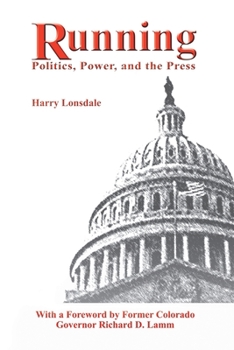
Running: Politics, Power, and the Press

Running is about electoral politics in America today. Here is a first-hand account of what it's like to run for office in the era when TV ads rule. It is also about the overwhelming power of money in politics and how that money-power is thwarting the will of the people, dividing our country, and eroding our democracy. Anyone who has ever considered running for office and would like to experience it vicariously...the endless days, the begging for money, the excitement, fear, frustration, rewards, and the pain of being trashed by the press...will enjoy this book. * * * * * "A terrific introduction on the reality of campaigning, Harry Lonsdale brilliantly expresses the tiny frustrations and victories any political hopeful must face. Lonsdale's honest, personal account exposes the flaws and unexpected virtues he encounters in his engaging story - Running definitely leaves its readers entertained and inspired." Jimmy Carter "Lonsdale took his 'independent' candidacies for elective national office in Oregon further up the cliff of the two-party duopoly than anyone else in the country. From this vantage point, he keeps the reader engrossed with his stories, insight, and reforms. Shows you the nitty-gritty of politics and how to end it with a new beginning." Ralph Nader "Running for political office in America has become an unnatural act...the constant degradation of asking fat cats for money, the unseemly scramble for media attention, the bone-wearying and mind-numbing marathon that seem endless, and the fear that rides everywhere with the candidate. No wonder we get less than the best in office Take a ride with Harry Lonsdale...a candidate who tried to do politics right--and who has some ideas on how to fix the money-grubbing system that is failing our democracy." Jim Hightower Author of: If The Gods Had Meant Us To Vote They Would Have Given Us Candidates "Harry Lonsdale writes with fervor about running for the U. S. Senate and championing Campaign Finance Reform. A thought provoking must read for the politically and not so politically inclined." Former U. S. Senator Bill Bradley "Have you ever wondered what it was like to run for office and get defeated, or wondered if you decided to run, how you would go about it? Step by step? Or what's the answer to Campaign Finance Reform and who's working on it? Harry Lonsdale's book Running is both enlightening and a joy to read. You wouldn't expect a page-turner would you? But that's what it is." Granny D (Doris Haddock)
Campaign Finance Reform Activist
Campaign Finance Reform Activist
Format:Paperback
Language:English
ISBN:0759676267
ISBN13:9780759676268
Release Date:September 2002
Publisher:Authorhouse
Length:216 Pages
Weight:0.10 lbs.
Dimensions:0.5" x 6.1" x 9.0"
Customer Reviews
4 ratings
Riveting examination of the decline of our democracy.
Published by Thriftbooks.com User , 22 years ago
Harry Lonsdale is little known outside Oregon, but he shook up the state's political world in the 1990s. A millionaire scientist/businessman from central Oregon, Lonsdale's environmental concerns spurred him to run against Oregon political titan Mark Hatfield in the latter's 1990 run for a fifth term in the US Senate. Hatfield was the aging golden boy of Oregon politics. Elected to the Oregon House and Senate, as Oregon Secretary of State, two terms as governor, and then five terms in the US Senate, Hatfield owed much of his success to his reputation as a moderate, dovish Republican, who opposed defense buildups and used the power of the Senate Appropriations Committee (of which he was chair) to funnel billions of dollars into his home state. Hatfield's persona as a gentleman politician was a false one, however, as Lonsdale demonstrates throughout his account of their 1990 battle. Hatfield abused his power to control the Oregon media, instigate investigations into Lonsdale's past (which proved fruitless), and to raise millions of dollars in PAC and special interest money, which he used to fund a series of negative TV ads--ads which eventually won him the election. If anything, this book is valuable as an insight into the real Mark Hatfield, a dishonest, career politician whose only interest was staying in office and maintaining his own power. Lonsdale, on the other hand, initially had little going for him beside his own millions, which he poured into his campaign. They came in handy. By using his fortune, Lonsdale won the Democratic nomination and was able to get his message--against clearcutting of Oregon's forests, pro-choice, pro-campaign finance reform--out to the public. By September 1990, Lonsdale was leading in the polls, and Hatfield rushed back from Washington, desperate to retain his position. The race remained virtually neck-and-neck until election day, when Hatfield finally won 53%-46%--a result unprecedented in its slim margin of victory for the "invulnerable" incumbent.Two years later, Lonsdale ran again, facing Congressman Les AuCoin in the Democratic primary. Again, money made the difference, and with the Oregon press leaning characteristically towards well-known politicians, AuCoin's special interest cash and the media's anti-Lonsdale editorials eventually led to AuCoin's triumph--by only 300 votes out of over 300,000 cast! AuCoin went on to defeat against the notorious Bob Packwood. Lonsdale's final race in 1996, again in the Democratic primary, was less successful than the first two, as he was swamped early and decisively by a millionaire whose financial clout proved overwhelming. "Running," then, is more than just a fascinating and gripping political memoir. It is also a revealing and somewhat depressing examination of the state of American electoral politics, with the incessant fundraising, special interests, and a politically controlled media proving more decisive, in the end, than the will (let alone the bes
Why the best man doesn't always win in American politics
Published by Thriftbooks.com User , 22 years ago
Running: Politics, Power, And The Press by Harry Lonsdale is a "tell-all" account of what it is really like to run for political office in America today. From the difficulties of fund raising; to proposals for campaign finance reform; to simply having to try again when one's first run for office doesn't work, Running: Politics, Power, And The Press studies why the best man doesn't always win in American-style politics, and what it takes to truly handle the complex process of surviving an election. If you are considering a run for elected office (or are a supporter of someone who is) then give a close and careful reading to Harry Lonsdale's Running: Politics, Power, And The Press!
Behind Political Scenes
Published by Thriftbooks.com User , 23 years ago
Regardless of your political affiliation, if you're interested in what goes on behind the scenes in a contemporary political campaign, this is the book to read. Having read it, I believe you will, like me, become deeply concerned about the future of our country and thus your future and that of your family.
Interesting campaign memoir
Published by Thriftbooks.com User , 23 years ago
It is the 7th game of the world series. The pitcher walks to the umpire and hands him ten thousand dollars. The batter hands the ump five thousand dollars. The ump says "Play Ball". Throughout the game the umpire makes close calls and gets handed money by the players. Throughout, the ump says that he was not influenced in his calls by the money. Welcome to American politics. Harry Lonsdale is a well known figure from Oregon's recent political past--a three time candidate for U.S. Senator. This book describes the process of running for high office, and losing, from the mellowed perspective of seven to twelve years' time.The book is a must-read for anyone running, or helping someone run, for high political office, especially in Oregon. And it will give the much wider audience of the tens of thousands of people who receive fundraising calls from candidates some sense of the anguish on the other end of the line. It gives a detailed view of the process of running: his motivation to run, the setting up a campaign staff, speechmaking, handshaking, meeting-going, and especially of the numbing process of dialing for dollars from individual contributors. It was most detailed in its view of the 1990 election between Mark Hatfield and Harry Lonsdale, Hatfield's only close brush with electoral defeat.The book isn't a tell-all. No great secrets are finally told. And it isn't particularly a book of score-settling. A number of people disappointed Harry over the years (particularly senior Democrats who thought they would 'back a winner' and supported Hatfield) but Harry is quite kind to those people. The news media angered Harry, but the anger has mellowed into disappointment and resignation that the news media are simply businesses, in it for the money, not the opportunity to create a better democracy. Mssrs. Goldschmidt, AuCoin, Hatfield, and Packwood are all described negatively, as is most of the news media, but the comments aren't meanspirited, and are positively fairminded when compared to the 30-second attack ads that marked the campaign wars.Harry describes the power of money in politics, from the unique vantage point of someone who had some (which allowed him to be the candidate to take on Hatfield in 1990) and of someone who didn't have enough (when he lost to the even richer Tom Bruggere in 1996).Harry learned at first hand the close relation between money and political power and he suggests some solutions: campaign finance reform, greater access by candidates to the public airways. This book confirms that Harry is still an idealist, still a liberal, still an environmentalist, and still an outsider trying to change the system.
Copyright © 2026 Thriftbooks.com Terms of Use
| Privacy Policy | Do Not
Sell/Share My Personal Information | Cookie Policy | Cookie Preferences | Accessibility Statement
ThriftBooks® and the ThriftBooks® logo are registered trademarks of Thrift Books Global, LLC
ThriftBooks® and the ThriftBooks® logo are registered trademarks of Thrift Books Global, LLC
