


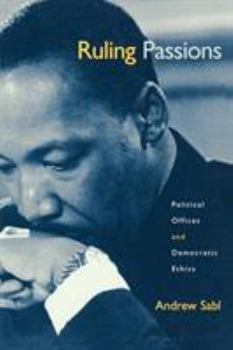
Ruling Passions: Political Offices and Democratic Ethics

Select Format
Select Condition 
Book Overview
How should politicians act? When should they try to lead public opinion and when should they follow it? Should politicians see themselves as experts, whose opinions have greater authority than other people's, or as participants in a common dialogue with ordinary citizens? When do virtues like toleration and willingness to compromise deteriorate into moral weakness? In this innovative work, Andrew Sabl answers these questions by exploring what a democratic polity needs from its leaders. He concludes that there are systematic, principled reasons for the holders of divergent political offices or roles to act differently.
Sabl argues that the morally committed civil rights activist, the elected representative pursuing legislative results, and the grassroots organizer determined to empower ordinary citizens all have crucial democratic functions. But they are different functions, calling for different practices and different qualities of political character. To make this case, he draws on political theory, moral philosophy, leadership studies, and biographical examples ranging from Everett Dirksen to Ella Baker, Frances Willard to Stokely Carmichael, Martin Luther King Jr. to Joe McCarthy.Ruling Passions asks democratic theorists to pay more attention to the "governing pluralism" that characterizes a diverse, complex democracy. It challenges moral philosophy to adapt its prescriptions to the real requirements of democratic life, to pay more attention to the virtues of political compromise and the varieties of human character. And it calls on all democratic citizens to appreciate "democratic constancy" the limited yet serious standard of ethical character to which imperfect democratic citizens may rightly hold their leaders--and themselves.
Format:Paperback
Language:English
ISBN:0691088314
ISBN13:9780691088310
Release Date:February 2002
Publisher:Princeton University Press
Length:368 Pages
Weight:0.95 lbs.
Dimensions:0.9" x 6.5" x 8.8"
Customer Reviews
1 rating
A Breath of Fresh Air
Published by Thriftbooks.com User , 24 years ago
Andrew Sabl has written that most unusual of documents: a book on political theory that will be of real use to those who actually practice politics, including those of us who exercise the supreme office of citizen and voter. Facing squarely the problems set by the existence of real moral disagreements and the real contention of interests, he asks how the holders of what he calls "offices" (which others of a more sociological turn might call "roles") ought to act if the project of democratic self-rule is to be carried through. He argues -- convicingly, at least to me -- that different offices imply different sets of moral guidelines: that a good senator and a good community organizer are good in different ways, and that neither one can fulfill his office simply by acting out in public some version (any version) of what private ethics defines as a good person.As a bonus, Sabl writes clearly and elegantly; Ruling Passions is a pleasure to read. A must for the scholar, the book is completely accessible to the general reader who is willing to stretch his mind just a little.
Copyright © 2026 Thriftbooks.com Terms of Use
| Privacy Policy | Do Not
Sell/Share My Personal Information | Cookie Policy | Cookie Preferences | Accessibility Statement
ThriftBooks® and the ThriftBooks® logo are registered trademarks of Thrift Books Global, LLC
ThriftBooks® and the ThriftBooks® logo are registered trademarks of Thrift Books Global, LLC
