


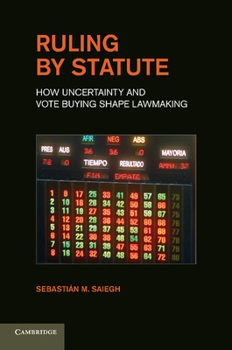
Ruling by Statute
No Customer Reviews

What are the main factors that allow presidents and prime ministers to enact policy through acts of government that carry the force of law? Or, simply put, when does a government actually govern? The theory presented in this book provides a major advance in our understanding of statutory policy making. Using a combination of an original analytical framework and statistical techniques, as well as historical and contemporary case studies, the book demonstrates that, contrary to conventional wisdom, variations in legislative passage rates are the consequences of differences in uncertainty, not partisan support. In particular, it shows that a chief executive's legislative success depends on the predictability of legislators' voting behavior and whether buying votes is a feasible option. From a normative standpoint, the book reveals that governability is best served when the opposition has realistic chances of occasionally defeating the executive in the legislative arena.
Format:Paperback
Language:English
ISBN:1107618002
ISBN13:9781107618008
Release Date:January 2014
Publisher:Cambridge University Press
Length:250 Pages
Weight:0.82 lbs.
Dimensions:0.6" x 6.0" x 9.0"
Customer Reviews
0 rating
Copyright © 2026 Thriftbooks.com Terms of Use
| Privacy Policy | Do Not
Sell/Share My Personal Information | Cookie Policy | Cookie Preferences | Accessibility Statement
ThriftBooks® and the ThriftBooks® logo are registered trademarks of Thrift Books Global, LLC
ThriftBooks® and the ThriftBooks® logo are registered trademarks of Thrift Books Global, LLC
