


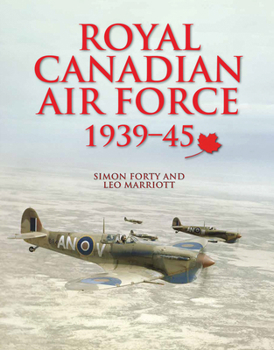
Royal Canadian Air Force: 1939-45

When Canada entered World War II, in 1939, the Royal Canadian Air Force had a glorious history from World War I, but hardly any technical advancement from that era. The RCAF had a meager strength of 4,000 men, and only 270 aircraft, nearly all of them obsolete.
By the end of the war, there were 250,000 men and women in service, and the world's 4th largest air force with 47 squadrons overseas and 28 squadrons in North America.
After Dunkirk, as the tattered remains of Britain's best troops and devastated air force returned home without their heavy weapons, the Canadians took over the defense of southeast England. At the same time, Canada sent virtually all if its disposable weapons resources to Britain, and geared up for 6 years of intense battle.
During the War, the RCAF's command was Canadian but the constituent flyers were also Polish, Belgian, British and American. There was heavy fighting over Germany, Holland and France, but also in the Aleutian Islands, Burma, Italy and over the Atlantic.
In Europe, the RCAF was involved in the invasion from D-Day to V-E Day, taking on the Luftwaffe and ferocious anti-aircraft fire over Germany, France, over the Rhine at Bienen and Groningen as the Allies advanced into Germany.
This is a pictorial and textual history: there are hundreds of period photographs, and maps that illustrate action on all of the fronts. In addition, there are pictures of what the battlefields look like today, after 75 years of healing, and profiles of the aces and leaders.
Related Subjects
HistoryCustomer Reviews
ThriftBooks® and the ThriftBooks® logo are registered trademarks of Thrift Books Global, LLC
