


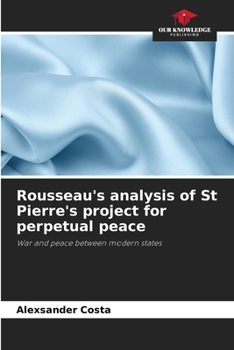
Rousseau's analysis of St Pierre's project for perpetual peace
No Customer Reviews

Saint-Pierre envisages perpetual peace in Europe through institutionalised conditions in order to legitimise a space that aims to facilitate a unified market between the member states. On the other hand, Jean-Jacques Rousseau believes that Saint-Pierre's thinking is impregnated with naivety when it comes to the sovereigns' policy of government and, furthermore, because he believes that, mediated by a confederative assembly, the princes would voluntarily agree to be part of this project of perpetual peace. However, Rousseau doesn't consider it impossible to realise this project, but in order to obtain peace, force is necessary. Faced with this debate, who would be right? Understanding this debate was only possible through analysing the primary works of the aforementioned thinkers and the necessary theoretical background of specialists, such as Evaldo Becker, Gelson Fonseca Jr, Luiz Felipe de Andrade e Silva Sahd, Jos Oscar de Almeida Marques, Jos Benedito de Almeida Jr. who provided a broad understanding of the fundamental concepts elaborated by the Genevan philosopher and the themes that touch on the relationship between states.
Format:Paperback
Language:English
ISBN:6208112249
ISBN13:9786208112240
Release Date:September 2024
Publisher:Our Knowledge Publishing
Length:92 Pages
Weight:0.32 lbs.
Dimensions:0.2" x 6.0" x 9.0"
Related Subjects
PhilosophyCustomer Reviews
0 rating
Copyright © 2026 Thriftbooks.com
Terms of Use | Privacy Policy | Do Not Sell/Share My Personal Information | Cookie Policy | Cookie Preferences | Accessibility Statement
ThriftBooks ® and the ThriftBooks ® logo are registered trademarks of Thrift Books Global, LLC
ThriftBooks ® and the ThriftBooks ® logo are registered trademarks of Thrift Books Global, LLC
