


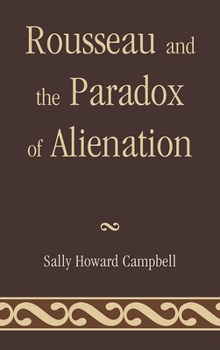
Rousseau and the Paradox of Alienation
No Customer Reviews

In the writings of Jean-Jacques Rousseau, Sally Howard Campbell finds the bridge between the now-dominant psycho-social conception of alienation and the legal-political conception that prevailed prior to Rousseau. She discusses Rousseau's transformation of the concept of alienation and how it laid much of the groundwork for Marx's later, more explicit discussions of man's alienation. Using Discourse on the Origin and Foundations of Inequality, Campbell shows how Rousseau depicts the development of man's awareness of himself as a conscious and moral being, illustrating man's journey from a natural state of self-sufficiency to one of dependence and alienation. Paradoxically, she describes Rousseau's belief that a state of wholeness can only be achieved through a man's total alienation of himself to the community, free from the alienating effects of civil society. She concludes that, like Marx, Rousseau believed that alienation can only be transcended through the merging of the individual and the community.
Format:Hardcover
Language:English
ISBN:0739166328
ISBN13:9780739166321
Release Date:January 2012
Publisher:Lexington Books
Length:110 Pages
Weight:0.70 lbs.
Dimensions:0.5" x 5.9" x 9.3"
Age Range:22 years and up
Grade Range:Postsecondary and higher
Customer Reviews
0 rating
Copyright © 2026 Thriftbooks.com Terms of Use
| Privacy Policy | Do Not
Sell/Share My Personal Information | Cookie Policy | Cookie Preferences | Accessibility Statement
ThriftBooks® and the ThriftBooks® logo are registered trademarks of Thrift Books Global, LLC
ThriftBooks® and the ThriftBooks® logo are registered trademarks of Thrift Books Global, LLC
