


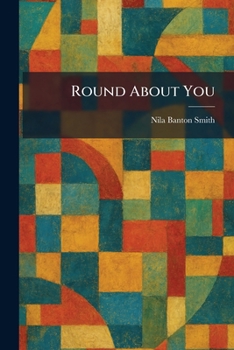
Round About You

Select Format
Select Condition 
Book Overview
"Round About You" is an influential primary reading textbook designed to cultivate literacy and engagement in young students through the unit-activity method. Created by renowned educator Nila Banton Smith, this work represents a significant milestone in early twentieth-century pedagogy, utilizing a structured approach to introduce children to the world of reading through relatable narratives and thematic units.
The book centers on the everyday experiences of children, exploring themes of community, nature, and domestic life. Through carefully selected vocabulary and rhythmic repetition, it guides learners through the foundational stages of language arts. The text emphasizes the connection between activity and learning, reflecting progressive educational theories that prioritize comprehension over rote memorization. By presenting stories that mirror the child's immediate environment, "Round About You" seeks to build both technical skill and a genuine interest in literature. This foundational work stands as a vital example of historical teaching methods and the evolution of reading curricula, offering a charming and educational look at the social and instructional standards of its era.
This work has been selected by scholars as being culturally important, and is part of the knowledge base of civilization as we know it. This work was reproduced from the original artifact, and remains as true to the original work as possible. Therefore, you may see the original copyright references, library stamps (as most of these works have been housed in our most important libraries around the world), and other notations in the work.
This work is in the public domain in the United States of America, and possibly other nations. Within the United States, you may freely copy and distribute this work, as no entity (individual or corporate) has a copyright on the body of the work.
As a reproduction of a historical artifact, this work may contain missing or blurred pages, poor pictures, errant marks, etc. Scholars believe, and we concur, that this work is important enough to be preserved, reproduced, and made generally available to the public. We appreciate your support of the preservation process, and thank you for being an important part of keeping this knowledge alive and relevant.
Customer Reviews
ThriftBooks ® and the ThriftBooks ® logo are registered trademarks of Thrift Books Global, LLC
