


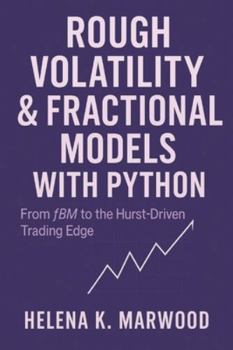
Rough Volatility & Fractional Models with Python: From fBM to the Hurst-Driven Trading Edge: Modeling Volatility Roughness, Extracting Fractional Sign

The volatility surface is broken. Rough volatility explains why.
This book delivers the most accessible, practical, and comprehensive guide to rough volatility, fractional Brownian motion (fBM), and Hurst-driven modeling ever written for quantitative traders and financial engineers.
If you have struggled to understand why standard stochastic volatility models fail, or why modern markets behave with "memory" and microstructure-induced roughness, this book gives you the complete framework, intuition, and Python workflows to build the next generation of volatility models and trading systems.
What This Book Teaches You- The core intuition behind rough volatility
Why volatility is not smooth, why it cannot be modeled with classical Brownian motion, and how fractional processes capture long-memory behavior in real markets.
- Fractional Brownian motion (fBM) from zero to mastery
Step-by-step construction, parameterization, simulation, and calibration. Learn Hurst exponents the right way - intuitively first, then rigorously.
- Full rough volatility model implementations in Python
Including:
- The Rough Bergomi Model
- Fractional Stochastic Volatility (fSV)
- Multi-factor fractional models
- Hybrid neural/fractional architectures
All presented with clean, reusable code templates.
- How rough volatility transforms trading
Use fractional features to detect volatility clustering, regime shifts, option mispricings, and structural breaks that traditional models miss.
- Complete volatility trading systems
Concrete, plug-and-play strategies built from fractional features:
- Hurst-driven volatility filters
- fBM momentum/anti-momentum signals
- Rough volatility mean-reversion engines
- Volatility-of-volatility predictors
Includes full Python implementations.
Classical models assume volatility is smooth, Markovian, and memoryless. Modern markets are the opposite. They are rough, self-similar, and exhibit long-range dependence - and this book shows how to model that structure directly.
Rough volatility is not an academic curiosity. It is the new foundation of volatility modeling at banks, hedge funds, and derivatives desks worldwide.
Who This Book Is ForQuant traders, systematic volatility researchers, derivatives professionals, financial engineers, and advanced Python quants who want to push beyond Black-Scholes-era assumptions and into the future of stochastic modeling.
If you want to understand how volatility really behaves, and build trading systems that exploit it, this is the most practical, complete, and modern guide available.Customer Reviews
ThriftBooks ® and the ThriftBooks ® logo are registered trademarks of Thrift Books Global, LLC
