


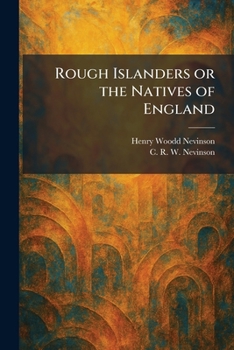
Rough Islanders or the Natives of England

"Rough Islanders or the Natives of England" offers a profound and observant examination of the English national character during the early 20th century. Written by the esteemed journalist Henry Woodd Nevinson and featuring illustrations by the renowned artist C. R. W. Nevinson, this work delves into the various social strata, traditions, and idiosyncratic behaviors that define the British people. From the industrial heartlands to the quiet rural villages, the book captures the essence of a nation navigating the complexities of the interwar period.
The narrative explores themes of class, politics, and daily life, providing a vivid portrait of the Islanders across all walks of life. Nevinson's keen journalistic eye provides a blend of wit, empathy, and critical insight, making this a significant piece of social commentary. Readers will find a detailed exploration of what it meant to be English in a time of transition, touching upon the resilience, stoicism, and unique cultural peculiarities of the population. "Rough Islanders or the Natives of England" serves as both a vital historical document and a compelling literary reflection on national identity, presented with the depth and nuance characteristic of its authors.
This work has been selected by scholars as being culturally important, and is part of the knowledge base of civilization as we know it. This work was reproduced from the original artifact, and remains as true to the original work as possible. Therefore, you may see the original copyright references, library stamps (as most of these works have been housed in our most important libraries around the world), and other notations in the work.
This work is in the public domain in the United States of America, and possibly other nations. Within the United States, you may freely copy and distribute this work, as no entity (individual or corporate) has a copyright on the body of the work.
As a reproduction of a historical artifact, this work may contain missing or blurred pages, poor pictures, errant marks, etc. Scholars believe, and we concur, that this work is important enough to be preserved, reproduced, and made generally available to the public. We appreciate your support of the preservation process, and thank you for being an important part of keeping this knowledge alive and relevant.
Customer Reviews
ThriftBooks ® and the ThriftBooks ® logo are registered trademarks of Thrift Books Global, LLC
