
Skip to content
Scan a barcode
Scan
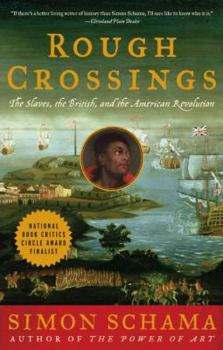
Paperback Rough Crossings: Britain, the Slaves and the American Revolution Book

ISBN: 0060539178

ISBN13: 9780060539177

Rough Crossings: Britain, the Slaves and the American Revolution

Select Format

Select Condition ThriftBooks Help Icon

Recommended

Format: Paperback

Condition: Very Good

$6.69
Save $10.30!
List Price $16.99
Almost Gone, Only 2 Left!
Save to List

Book Overview

"The most dramatic account so far of the extraordinary expeience of slaves in and after the American Revolution. . . . Schama's gift for plunging us into the very center of the action makes reading an exhilarating and often moving experience."--Daily Telegraph

If you were black in America at the start of the Revolutionary War, whom would you want to win? In response to a declaration by the last governor of Virginia that any rebel-owned slave who escaped and served the King would be emancpated, tens of thousands of blacks voted with feet, escaping to fight beside the British. Originally designed to break the plantations of the American South, this military strategy instead unleashed one of the great exoduses in American history.

Told in the voices of the slaves and the white abolitionists who aided them, Simon Schama vividly details the odyssey of these escaped blacks, shedding light on an extraordinary chapter in America's birth.


Rough Crossings reveals a forgotten front of the Revolutionary War, where the fight for freedom was truly a matter of life and death--and the sides were not as clear as we've been told.


A Forgotten History: Discover why tens of thousands of enslaved people risked everything to side with the British, seeing King George III, not the Founding Fathers, as their potential liberator.The Founding Fathers' Dilemma: Uncover the "dirty little secret" of the Revolution as prominent Patriots like George Washington and Thomas Jefferson watch their own enslaved workers flee to fight against the American cause.From Nova Scotia to Sierra Leone: Follow the dramatic, often tragic journey of the Black Loyalists from the battlefields of the South to the harsh settlements of Nova Scotia and, for some, a return to Africa to found a new colony of free people.Narrative History at its Finest: Through the vivid, immersive storytelling that has made Simon Schama a master of the genre, this account is told through the diaries, letters, and records of the people who lived it.

Customer Reviews

5 ratings

The most readable historian

Simon Schama is the most readable of historians. Citizens was brilliant, but a bit of a grind to get through. More recently, he's published books like this. Important topics delivered with confidence, and often with new perspectives. His fame is well deserved.

Another Perspective on American Independence

Schama is always an interesting writer, but he has seldom been as easy to read as in Rough Crossings. Perhaps the subject itself is so unambiguous that he finds his way to simplicity. That subject is the fate of African and African-American refugees from the Thirteen Colonies, the bold proclaimers of Liberty, during and after the Revolutionary War. Unmentioned in most American textbooks of history, thousands of slaves and some free blacks took refuge with the British army and navy during the war. After the war, many of them were transported to other British lands, especially to Nova Scotia. Schama details their hopes and their misery quite eloquently. Eventually, the tale focuses on the efforts of English abolitionists to establish a "homeland" for liberated American and British slaves in Sierra Leone. The English abolitionists, especially John Clarkson, are the central personages of the book, but the former slaves themselves are the most compelling figures. For a sometime-American reader like myself, the most enlightening portion of this book comes first, i.e. the chapters that describe the role of the defense of slavery in the southern colonies against perceived threats of abolition and strategic offers of freedom from Britain. The motives of our Founding Fathers, in other words, were not always as idealistic as we were taught. An understanding of the American Revolution can't always be limited to Boston and taxes. The story of Virginian expansionism, the problems of colonial indebtedness, and colonial racism towards both slaves and Native Americans must also be told, and Schama does a good part of that job. Particularly revealing are Schama's pages devoted to George Washington, whose slaves were as willing to run away to the British as most others. Inevitably, certain British generals who have been execrated in American history books emerge as more sympathetic and honorable than "we" expect. I don't want to "spoil" the narrative with too many revelations; taken as a "novel of facts", Rough Crossings is an exciting book to read, with plenty of picturesque scenes, humorous encounters, pathos and rage. The book won and deserved to win the National Book Critics Circle Award.

Is British Air Really Too Pure ?

This well written and informative book provides yet another useful reminder that Americans like me shouldn't be too smug about being shining beacons of freedom throughout the world. It goes into interesting detail about the debates in the Continental Congress on slavery prior to the Revolution, the compromises made, and who made them. The British offered freedom to slaves who came over to their side during the Revolutionary War, and they actually tried to keep these promises, but not always to the satisfaction of the freed slaves. However, a movement to abolish the slave trade was gathering momentum in Britain, one result of which was the establishment of the state of Sierra Leone in West Africa as a home for many of these formerly enslaved people and their families. It is a very interesting story, and the author tells it in a lively style. However, I can't help wondering if the author hasn't applied a little melodrama to add sparkle to his story; for example, individuals and groups of individuals tend to be characterized as all good or all bad. The author also uses rather nasty sarcasm in describing people and events. I can see his point in using it to describe George Washington's hypocrisy, but he also uses it when talking about Granville Sharp, who may have been quite an eccentric but nonetheless was a leading figure in abolishing the slave trade. It seemed mean-spirited. Finally, I wish I had counted the number of times the author referred to British air as being "too pure for slaves to breathe." Maybe it was, but that never stopped the British from fouling other countries' air: India, Australia, South Africa, etc., etc., etc. On the whole, I recommend this book as a readable history of an important but not widely discussed event in the establishment of the United States.

A new facet of US history

Schama has done a service to us all through this book, which provides a look at how people in the 18th century interpreted the phrase "all men are created equal." The British by and large were far more willing to include blacks in that category than the people of the United States. Slaves who escaped and fought for the British were promised their freedom. Not every promise was kept, but many were. After the war, Schama takes us along with the freed slaves as they are shuttled to Nova Scotia and eventually Sierra Leone, as they demanded and fought for the freedom due to them by virtue of their service in the British army. The text is very well written and footnoted; the author understands that well-told history is told in (true) stories. The book's only miscue is Schama's subtle mocking of the religious fervor of the freed slaves and abolitionists. Highly recommended.

Are we misled about the real reasons for the success of the American revolution?

Amazing, amazing, amazing. This is one of the best audiobooks I purchased recently. In the last several years, the academic establishment has completely rewritten our view of the American revolution. First, Hochschild wrote "Bury the Chains." Next, Blumrosen penned "Slave Nation." Today: "Rough Crossings." Although different books, these volumes establish that abolitionists in England were starting to seriously involve the Courts in limiting "that accursed thing - slavery" on British soil, and that the Africans in bondage were learning of English attitudes. Slave insurrections were in the air. After Bunker Hill, the British encouraged slaves to fight against their masters...this was intolerable to many Southerners so they joined with the Northern patriots to split from England. Only in this way could the South guarantee the protection of slavery on American soil. The hypothesis is not as wild as it sounds and is ably discussed in all three books. My favorite is Simon Schama's magisterial analysis...because he is such a good storyteller. He is also a terrific narrator who reads with profound conviction about the efforts of blacks and sympathetic whites to end the intolerable institution of African bondage. True, the British promised Blacks their freedom; in response the American patriots promised to enslave more Blacks as property bonuses to soldiers after victory. Put in another way, the American revolution looks entirely different depending on the color of the "patriot." We learn that even Patrick Henry had a slave...so much for talk about liberty and death. "Rough Crossings" is a story of real villains and real heroes. We are lucky to have such a wonderful researcher and narrator offer us these engaging perspectives. I recommend this book without reservation.
Copyright © 2026 Thriftbooks.com Terms of Use | Privacy Policy | Do Not Sell/Share My Personal Information | Cookie Policy | Cookie Preferences | Accessibility Statement
ThriftBooks ® and the ThriftBooks ® logo are registered trademarks of Thrift Books Global, LLC

GoDaddy Verified and Secured