


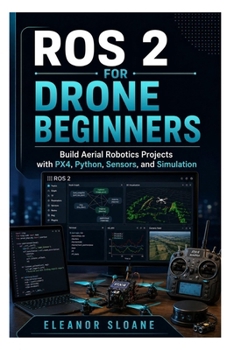
ROS 2 for Drone Beginners: Build Aerial Robotics Projects with PX4, Python, Sensors, and Simulation

A flight controller can keep an aircraft stable, but useful autonomy requires more. The vehicle must receive information, interpret sensor data, coordinate software components, make mission decisions, respond to failures, and confirm that each commanded action succeeded.
ROS 2 for Drone Beginners provides a practical, project-based introduction to developing aerial robotics applications with PX4, ROS 2, Python, cameras, sensors, and simulation.
Instead of placing every responsibility inside one oversized program, this guide teaches a layered architecture. PX4 handles flight-critical functions such as stabilisation, position control, motor outputs, flight modes, and failsafes. ROS 2 coordinates higher-level functions such as perception, planning, data recording, mission logic, and communication between specialised nodes.
Inside this hands-on guide, you will learn how to:
Install Ubuntu 24.04, ROS 2 Jazzy, PX4, Gazebo Harmonic, and QGroundControlUnderstand nodes, topics, messages, services, actions, parameters, and Quality of ServiceCreate organised ROS 2 workspaces and installable Python packagesBuild publishers, subscribers, launch files, configuration files, and reusable nodesConvert correctly between ENU and NED coordinate conventionsUse tf2, timestamps, simulation time, units, and reference framesConnect PX4 and ROS 2 through uXRCE-DDS and Micro XRCE-DDSWork with px4_msgs, message versions, topic directions, and compatible QoS settingsLaunch PX4 Software-in-the-Loop in GazeboRead position, attitude, battery, vehicle status, and sensor telemetryRecord and replay test data with rosbag2Design a safe Offboard control nodeCommand a simulated square-flight patternValidate rangefinders and detect stale or unreliable measurementsProcess camera images with OpenCV and cv_bridgeDetect a coloured inspection targetUnderstand EKF2 and validate external-position informationProcess point clouds and create a basic forward-obstacle monitorBuild mission state machines with clear transitions and abort conditionsCoordinate takeoff, searching, inspection, return, and landing tasksOrganise multi-vehicle systems with namespaces and unique identitiesDeploy selected nodes to a companion computerConfigure networking, automatic startup, logging, and resource monitoringDiagnose communication, frame, timing, discovery, and middleware faultsApply basic ROS 2 security and reproducible testing practicesThe projects progress from telemetry tools and sensor-processing nodes to simulated autonomous flights, camera-based perception, mission-management software, fleet monitoring, and companion-computer deployment.
The final capstone combines vehicle communication, perception, mission logic, safety rules, launch files, parameters, recorded data, and fault-injection tests in a complete autonomous search-and-inspect workflow.
Whether you are a robotics student, Python developer, drone technician, researcher, maker, or PX4 user, this guide will help you build modular systems that can be tested, diagnosed, and improved.
Start with isolated nodes. Validate the data. Rehearse the mission in simulation. Move toward hardware only when every layer behaves predictably.
Customer Reviews
ThriftBooks ® and the ThriftBooks ® logo are registered trademarks of Thrift Books Global, LLC
