


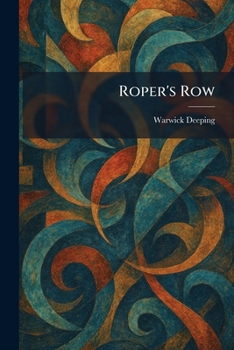
Roper's Row

Select Format
Select Condition 
Book Overview
"Roper's Row" is a powerful and moving narrative of social struggle, ambition, and personal triumph. The story centers on Christopher Hazzard, a brilliant but physically disabled young man born into the cramped, impoverished confines of a London backstreet. Driven by an intense desire to escape his circumstances and a profound calling to heal others, Christopher embarks on a grueling path toward becoming a medical doctor. His journey is one of immense hardship, defined by the stark contrasts between the grit of his upbringing and the cold prestige of the medical establishment.
Central to the work is the theme of selfless devotion, particularly that of Christopher's mother and a loyal companion, whose sacrifices provide the foundation for his education and survival. As Christopher navigates the competitive and often cruel world of professional medicine, he must reconcile his professional ambitions with his humble roots and the personal costs of his ascent. Warwick Deeping masterfully captures the atmosphere of early 20th-century England, offering a compassionate look at class barriers, the ethics of the medical profession, and the resilience of the human spirit. "Roper's Row" remains a poignant testament to the pursuit of excellence against all odds and the enduring power of maternal love.
This work has been selected by scholars as being culturally important, and is part of the knowledge base of civilization as we know it. This work was reproduced from the original artifact, and remains as true to the original work as possible. Therefore, you may see the original copyright references, library stamps (as most of these works have been housed in our most important libraries around the world), and other notations in the work.
This work is in the public domain in the United States of America, and possibly other nations. Within the United States, you may freely copy and distribute this work, as no entity (individual or corporate) has a copyright on the body of the work.
As a reproduction of a historical artifact, this work may contain missing or blurred pages, poor pictures, errant marks, etc. Scholars believe, and we concur, that this work is important enough to be preserved, reproduced, and made generally available to the public. We appreciate your support of the preservation process, and thank you for being an important part of keeping this knowledge alive and relevant.
Customer Reviews
ThriftBooks ® and the ThriftBooks ® logo are registered trademarks of Thrift Books Global, LLC
