


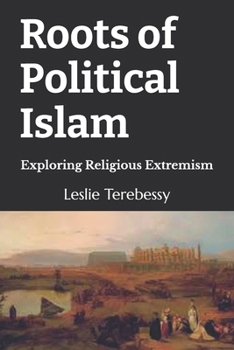
Roots of Political Islam: Exploring Religious Extremism
No Customer Reviews

Is Islam as practiced at present no different from Islam as practiced by Muslims when the Book of Allah was revealed?Traditionalists argue that Islam evolved in an unbroken process. But there are clues that there was a change, after all. Furthermore, it was a far-reaching change. There was a "break" from revelation as well as tradition. The "break" transpired when the umma turned from revelation to tradition. For the tradition of Muhammad was to follow revelation. The "change" was enabled by recourse to perceptions in defiance of key teachings of revelation. These encompass the treatment of tradition as "revelation," the repression of reason and recourse to the teaching of abrogation. The treatment of tradition as revelation produced traditionalism. Recourse to the teaching of abrogation engendered Islamism. What triggered this? Hawkish rulers required a rendition of revelation to justify wars of aggression waged for territorial expansion. This required a rearticulation of revelation as a teaching of war. This was expedited by the repression of reason, treating tradition as revelation, and recourse to the teaching of abrogation. The turn from revelation to tradition was buttressed by recording the traditions of the prophet, in defiance of his prohibition of recording his traditions. The traditions were reluctantly recorded by persons tasked with the recordings. For they remembered the prophet's prohibition of recording his traditions. To assuage their fears, Umar II stated that the prophet "abrogated" his prohibition of recording his traditions. The turn to tradition replaced the revelation-centric knowledge paradigm of the Book of Allah with a tradition-centric paradigm. Unfortunately, the turn from revelation to tradition corrupted the knowledge of revelation. Islam turned into Islamism in six phases. The first and sixth phases were political. The second stage witnessed the repression of reasoning by tradition. In the third stage, tradition would become a "part of" revelation. In the fourth phase, tradition became a "judge" of revelation. This required the subordination of revelation to tradition. The treatment of tradition as a judge of revelation was an expression of shirk, too. In the fifth stage, the verses of reconciliation in the Book of Allah would be abrogated and replaced by the verse of the sword and hawkish traditions. The transformation of Islam to Islamism was expedited by the repression of reason. This was achieved by recourse to a tradition that treats the use of reason in religion as kufr. In the third phase, tradition was treated as revelation. It was at this juncture that Islam became "traditional." The treatment of tradition as revelation was "justified" by recourse to a tradition in which the prophet said that his traditions were "similar" to the Book of Allah. In so far as tradition was treated as an "equal" of revelation, the designation of tradition as revelation amounted to scriptural shirk. Thus, the transformation of Islam into Islamism was enabled by a gradual encroachment upon tauhid. The fifth stage witnessed the abrogation of revelation by revelation, tradition, and the rulings of the ulama. The "abrogation" of revelation by tradition and the rulings of the ulama were expressions of juristic shirk. The sixth and last stage witnessed the embedding of the teaching of the clash of the realm of peace (dar al-Islam) with the realm of unbelief (dar al-kufr). Islamism furnished a justification for wars of territorial enlargement, known as jihad al-talab, or the sixth pillar of Islam. The aggressiveness of militant Islam brought defeats, as in the destruction of the Abbasids by the Mongols, the defeats of the Turks at the gates of Vienna, as well as the war in Afghanistan and the fall of Bagdad in 2003. Islamism places the umma on a warpath against the rest of humanity. Islamism is a threat to security. Thus, it requires being treated accordingly. If Muslims do not restrain extremists, others might.
Format:Paperback
Language:English
ISBN:B09X3PVQNH
ISBN13:9798448450846
Release Date:April 2022
Publisher:Independently Published
Length:174 Pages
Weight:0.53 lbs.
Dimensions:0.4" x 6.0" x 9.0"
Customer Reviews
0 rating
Copyright © 2026 Thriftbooks.com
Terms of Use | Privacy Policy | Do Not Sell/Share My Personal Information | Cookie Notice | Cookie Preferences | Accessibility Statement
ThriftBooks ® and the ThriftBooks ® logo are registered trademarks of Thrift Books Global, LLC
ThriftBooks ® and the ThriftBooks ® logo are registered trademarks of Thrift Books Global, LLC
