


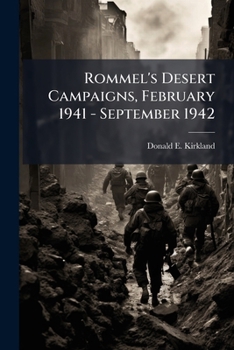
Rommel's Desert Campaigns, February 1941 - September 1942: A Study in Operational Level Weakness

This study is a historical analysis to determine why Rommel's tactical success on the battlefield could not accomplish strategic objectives in North Africa. Rommel's operations are reviewed from his arrival in North Africa in February 1941 through his last offensive to destroy the British Eighth Army at Alamein in August-September 1942. The study compares his ability to conduct tactical operations with his apparent inability to plan and execute actions at the operational level of war. Rommel's problems with operational planning are addressed within the scope of campaign planning principles set forth in FM 100-5, Operations, (Final Draft). His planning is expressly judged on how he shaped his operational plans by using the concepts of aims, resources, constraints, and restrictions to conform to strategic guidance. Rommel's tactical execution is contrasted with his operational performance. This comparison is based on the AirLand Battle tenets of agility, initiative, depth, and synchronization. The study concludes that Rommel's failure lies in planning operations that exceeded his resources and conducting needless operations that resulted in the loss of the initiative at the decisive point. Rommel's plans exceeded the strategic objectives desired by the theater strategists. His execution was ultimately defeated by his quest for tactical victories without regard to how they contributed to achieving campaign objectives. Rommel's weakness at the operational level led to failure to sequence tactical victories to achieve campaign goals. This failure illustrates the importance of understanding how operational art orchestrates tactical activities to achieve strategic objectives within a theater of operations.
This work has been selected by scholars as being culturally important, and is part of the knowledge base of civilization as we know it. This work was reproduced from the original artifact, and remains as true to the original work as possible. Therefore, you will see the original copyright references, library stamps (as most of these works have been housed in our most important libraries around the world), and other notations in the work.
This work is in the public domain in the United States of America, and possibly other nations. Within the United States, you may freely copy and distribute this work, as no entity (individual or corporate) has a copyright on the body of the work.
As a reproduction of a historical artifact, this work may contain missing or blurred pages, poor pictures, errant marks, etc. Scholars believe, and we concur, that this work is important enough to be preserved, reproduced, and made generally available to the public. We appreciate your support of the preservation process, and thank you for being an important part of keeping this knowledge alive and relevant.
Customer Reviews
ThriftBooks® and the ThriftBooks® logo are registered trademarks of Thrift Books Global, LLC
