


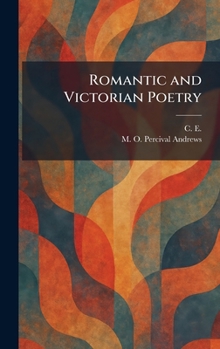
Romantic and Victorian Poetry

"Romantic and Victorian Poetry" is a comprehensive collection that showcases the evolution of British verse across two of the most influential periods in literary history. Compiled and edited by C. E. Andrews and M. O. Percival, this volume brings together the definitive works of the 19th century, capturing the transition from the passionate, nature-focused idealism of the Romantics to the complex industrial and social anxieties of the Victorian age.
Readers will find essential selections from masters of the craft, exploring themes of love, mortality, the sublime, and the changing landscape of Britain. This anthology serves as an indispensable resource for students and enthusiasts of English literature, providing a curated look at the lyrical innovations and stylistic shifts that defined an era. From the visionary lines of the early 1800s to the structured elegance of the late 19th century, "Romantic and Victorian Poetry" offers a profound journey through the voices that shaped modern poetic expression. The collection highlights the enduring relevance of these works, illustrating how they continue to resonate with contemporary audiences through their deep emotional depth and intellectual rigor.
This work has been selected by scholars as being culturally important, and is part of the knowledge base of civilization as we know it. This work was reproduced from the original artifact, and remains as true to the original work as possible. Therefore, you may see the original copyright references, library stamps (as most of these works have been housed in our most important libraries around the world), and other notations in the work.
This work is in the public domain in the United States of America, and possibly other nations. Within the United States, you may freely copy and distribute this work, as no entity (individual or corporate) has a copyright on the body of the work.
As a reproduction of a historical artifact, this work may contain missing or blurred pages, poor pictures, errant marks, etc. Scholars believe, and we concur, that this work is important enough to be preserved, reproduced, and made generally available to the public. We appreciate your support of the preservation process, and thank you for being an important part of keeping this knowledge alive and relevant.
Customer Reviews
ThriftBooks ® and the ThriftBooks ® logo are registered trademarks of Thrift Books Global, LLC
