


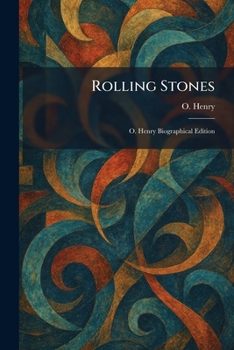
Rolling Stones: O. Henry Biographical Edition

"Rolling Stones" is a multifaceted collection that offers an intimate look into the diverse literary talents and creative evolution of William Sydney Porter, the master storyteller better known as O. Henry. This volume brings together a rich assortment of short stories, humorous sketches, verse, and personal correspondence, providing a comprehensive view of the author's stylistic range and wit.
Renowned for his clever wordplay and signature twist endings, O. Henry explores the ironies and nuances of human nature with his characteristic charm and empathy. The works within this collection showcase his sharp observational skills and his ability to find extraordinary narratives in the lives of ordinary people. Beyond his celebrated prose, the volume highlights the author's whimsical spirit and his history as a journalist and illustrator, offering a rare glimpse into the creative mind of one of America's most beloved writers.
From playful satire to poignant reflections, "Rolling Stones" serves as a vital testament to O. Henry's enduring legacy in American literature. It is an essential volume for readers seeking to understand the breadth of his work and the unique humor that defined his contribution to the short story genre.
This work has been selected by scholars as being culturally important, and is part of the knowledge base of civilization as we know it. This work was reproduced from the original artifact, and remains as true to the original work as possible. Therefore, you may see the original copyright references, library stamps (as most of these works have been housed in our most important libraries around the world), and other notations in the work.
This work is in the public domain in the United States of America, and possibly other nations. Within the United States, you may freely copy and distribute this work, as no entity (individual or corporate) has a copyright on the body of the work.
As a reproduction of a historical artifact, this work may contain missing or blurred pages, poor pictures, errant marks, etc. Scholars believe, and we concur, that this work is important enough to be preserved, reproduced, and made generally available to the public. We appreciate your support of the preservation process, and thank you for being an important part of keeping this knowledge alive and relevant.
Customer Reviews
ThriftBooks ® and the ThriftBooks ® logo are registered trademarks of Thrift Books Global, LLC
