


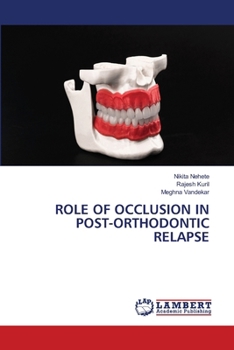
Role of Occlusion in Post-Orthodontic Relapse
No Customer Reviews

Orthodontic treatment aims not only to achieve ideal alignment but also to ensure long-term stability, which remains a major clinical challenge. Occlusion plays a vital role in this stability, representing a dynamic relationship between teeth, temporomandibular joints, masticatory muscles, periodontal structures, and neuromuscular control. Any imbalance within this system can lead to uneven force distribution, altered muscle activity, and adaptive tooth movement, resulting in post-orthodontic relapse. Relapse is not merely a return to the original malocclusion but a multifactorial process influenced by periodontal fibre memory, residual growth, neuromuscular adaptation, and occlusal discrepancies. Improper finishing, occlusal interferences, and discrepancies between centric relation and centric occlusion may contribute to instability. The components of occlusion continuously adapt to functional demands, and if teeth are positioned outside the zone of equilibrium, they may shift over time. Although retention helps maintain results, it cannot fully prevent relapse without proper occlusal harmony.In orthodontics, true success is not just how well we finish-but how well results endure.
Format:Paperback
Language:English
ISBN:6209879454
ISBN13:9786209879456
Release Date:April 2026
Publisher:LAP Lambert Academic Publishing
Length:104 Pages
Weight:0.34 lbs.
Dimensions:9.0" x 0.3" x 6.0"
Customer Reviews
0 rating
Copyright © 2026 Thriftbooks.com
Terms of Use | Privacy Policy | Do Not Sell/Share My Personal Information | Cookie Policy | Cookie Preferences | Accessibility Statement
ThriftBooks ® and the ThriftBooks ® logo are registered trademarks of Thrift Books Global, LLC
ThriftBooks ® and the ThriftBooks ® logo are registered trademarks of Thrift Books Global, LLC
