


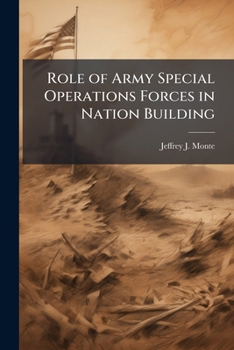
Role of Army Special Operations Forces in Nation Building

Although the United States (US) has been involved in nation-building efforts for the past 100 years it does not have a doctrinal definition to articulate what nation building is. Another challenge for the US is the lack of a designated agency within the US Government (USG) to lead the effort. First, an interagency, agreed upon, doctrinal definition of nation building must be established. Following this, each department and agency within the USG must be examined to identify the role each plays within a nation-building operation. This examination will allow the identification of the relationships between departments of the USG and the resources available to conduct nation building. This thesis examines the role of Army Special Operation Forces (ARSOF) in nation building. In order to do so, a definition of nation building is established, key tasks of nation building are derived, and military tasks that support a nation building operation are developed. These military tasks are analyzed against the doctrinal missions and capabilities of ARSOF in order to identify how ARSOF can contribute to nation building. This thesis concludes with recommendations on the employment of ARSOF in nation-building operations.
This work has been selected by scholars as being culturally important, and is part of the knowledge base of civilization as we know it. This work was reproduced from the original artifact, and remains as true to the original work as possible. Therefore, you will see the original copyright references, library stamps (as most of these works have been housed in our most important libraries around the world), and other notations in the work.
This work is in the public domain in the United States of America, and possibly other nations. Within the United States, you may freely copy and distribute this work, as no entity (individual or corporate) has a copyright on the body of the work.
As a reproduction of a historical artifact, this work may contain missing or blurred pages, poor pictures, errant marks, etc. Scholars believe, and we concur, that this work is important enough to be preserved, reproduced, and made generally available to the public. We appreciate your support of the preservation process, and thank you for being an important part of keeping this knowledge alive and relevant.
Related Subjects
Education Education & Reference History Political Science Politics & Social SciencesCustomer Reviews
ThriftBooks ® and the ThriftBooks ® logo are registered trademarks of Thrift Books Global, LLC
