


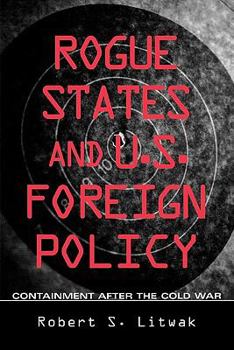
Rogue States and U.S. Foreign Policy: Containment after the Cold War

President Clinton and other U.S. officials have warned that "rogue states" pose a major threat to international peace in the post-Cold War era. But what exactly is a rogue state? Does the concept foster a sound approach to foreign policy, or is it, in the end, no more than a counterproductive political epithet? Robert Litwak traces the origins and development of rogue state policy and then assesses its efficacy through detailed case studies of Iraq, Iran, and North Korea. He shows that the policy is politically selective, inhibits the ability of U.S. policymakers to adapt to changed conditions, and has been rejected by the United States' major allies. Litwak concludes that by lumping and demonizing a disparate group of countries, the rogue state approach obscures understanding and distorts policymaking. In place of a generic and constricting strategy, he argues for the development of "differentiated" strategies of containment, tailored to the particular circumstances within individual states.
Format:Paperback
Language:English
ISBN:0943875978
ISBN13:9780943875972
Release Date:February 2000
Publisher:Woodrow Wilson Center Press
Length:312 Pages
Weight:1.15 lbs.
Dimensions:9.3" x 0.8" x 6.3"
Age Range:22 years and up
Grade Range:Postsecondary and higher
Customer Reviews
1 rating
Iraq, Iran, and North Korea Through the Eyes of An Idealist
Published by Thriftbooks.com User , 23 years ago
Litwak's analysis of the American designation of "rogue state" is excellent. He systematically critisizes current US policy and clearly lays out alternative policy approaches. This book was surprisingly engaging and is a MUST READ FOR ALL STUDENTS OF FOREIGN POLICY.
Copyright © 2026 Thriftbooks.com Terms of Use
| Privacy Policy | Do Not
Sell/Share My Personal Information | Cookie Policy | Cookie Preferences | Accessibility Statement
ThriftBooks® and the ThriftBooks® logo are registered trademarks of Thrift Books Global, LLC
ThriftBooks® and the ThriftBooks® logo are registered trademarks of Thrift Books Global, LLC
