


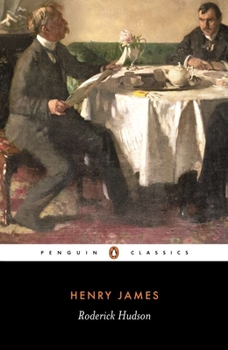
Roderick Hudson


Select Format
Select Condition 
Book Overview
When wealthy Rowland Mallet first sees a sculpture by Roderick Hudson, he is astounded and pronounces it to be a work of genius, and is equally entranced by the sculptor's beauty, spirit and charisma. Wishing to give the impoverished artist the opportunity to develop his talent, he takes Roderick from America to Rome, where he becomes the talk of the city. But Roderick soon loses his inspiration and Rowland loses control of his prot g , while both fall in love with women they cannot ever have. Can Roderick be saved from the path to self-destruction he seems set on? One of Henry James's first novels, Roderick Hudson (1875) is a compelling depiction of the artistic temperament and of a young man who, like Icarus, flies too close to the sun. For more than seventy years, Penguin has been the leading publisher of classic literature in the English-speaking world. With more than 1,700 titles, Penguin Classics represents a global bookshelf of the best works throughout history and across genres and disciplines. Readers trust the series to provide authoritative texts enhanced by introductions and notes by distinguished scholars and contemporary authors, as well as up-to-date translations by award-winning translators.
Format:Paperback
Language:English
ISBN:0140432647
ISBN13:9780140432640
Release Date:July 1986
Publisher:Penguin Classics
Length:400 Pages
Weight:0.54 lbs.
Dimensions:0.5" x 5.1" x 7.9"
Age Range:18 years and up
Grade Range:Postsecondary and higher
Customer Reviews
3 ratings
Readable early James
Published by Thriftbooks.com User , 15 years ago
Henry James's first full-length novel (1875) features a classic Jamesian situation, an entertaining, witty and tortuous examination of romantic feelings that are caught up in a frenzy of youthful impetuousness, ambition and artistic genius, complicated by the social expectations of others and the unfathomable workings of the female mind. If it isn't entirely successful on those terms, lacking the kind of precision that James would become better known for in later novels, there is however an interesting subtext to the story where James considers that other topic of interest to him regarding notions of identity from a European and an American perspective and whether there is any compatibility between them. Such matters are considered not so much through the titular character as through the figure of Rowland Mallet, a young man from New England, with no fixed place in the world, no great ambitions, no woman or love in his life and no genius of his own. As a buyer and importer of European art however, he can however recognise genius in others and is particularly taken by an exquisite piece of sculpture by a young local man, Roderick Hudson. Believing that he can do something to encourage such talent, he proposes taking the young inexperienced man on an extended trip to Rome, taking him away from his law studies and the quiet dullness of New England life and hopefully through his patronage, see his ability mature towards delivering the masterpieces he is confident lie within. Mallet almost immediately regrets his decision to leave Northampton however, since in the days before their departure he meets and is taken by Mary Garland, the demure daughter of a minister, a cousin of Roderick and his mother, but his feeling are further conflicted when the young sculptor, galvanised by the impending trip, himself proposes and becomes engaged to Miss Garland. Mallet's faith in Roderick's talent however proves to be well founded, and even though the young man shows a tendency towards dissipation while discovering the wonders of Europe, his ability flourishes during his stay in Rome, creating a number of works that are well received. Rowland must reluctantly accept the impulses and drives of artistic genius, but when Hudson threatens to throw it all away for the extraordinarily beautiful Christina Light, Mallet knows he must intervene and find a way of doing so that doesn't reveal or hinder his own interests. Miss Light is a typically complex, beautiful and intriguing Jamesian heroine (and brought back for The Princess Casamassima), but here in his first novel he doesn't quite get to grips with her character. Hudson too is rather predictable in his playing the part of impetuous youth, while Mallet is a little more likeable and intriguing, but not particularly complex, hesitant, always maddingly reasonable (even in the remarkable having-it-all out with Roderick conversation at the end of the novel), but remaining an outsider to events in the usual Henry Jame
Early James, Italy and the American
Published by Thriftbooks.com User , 18 years ago
Henry James brings Americans to Italy - and the Americans act American. There are a few stumbles in this book that don't detract from the story nor from Jame's voice. The semi-sophisticated American brings a hopeful artist, also American, to beautiful Italy, where the artist, instead of acting like a European artist, acts like a spoiled child. Roderick displays all that Europeans hate and love about Americans. And he gets away with it. It is only when his Mother and fiance arrive that the story turns from a soap opera into a tragedy. I happen to love Jame's later works and found this story exhibiting all the promise of his later books.
It's Funny That I'm the First...
Published by Thriftbooks.com User , 26 years ago
I wonder why the discrimination (is it ignorance?) exists regarding James's first great work, "Roderick Hudson." Yes, it is early James, and yes, snobs, it is very "readable." It's a page turner, the sentences are short, and the clauses only interfere in the early chapters, as James revised this earliest work with woefully-advised insertions of his later style. Once you get past these early chapters, however, you will be carried along - there are a few laughs as colorless Rowland Mallet tries to rein in the wild, sensitive Roderick. Much of the action takes place in Italy - and you get to meet the delicious Princess Casamassima (at this point, Judith Light), to boot. A real winner - for me, second only to "Portrait of a Lady"---
Copyright © 2026 Thriftbooks.com Terms of Use
| Privacy Policy | Do Not
Sell/Share My Personal Information | Cookie Policy | Cookie Preferences | Accessibility Statement
ThriftBooks® and the ThriftBooks® logo are registered trademarks of Thrift Books Global, LLC
ThriftBooks® and the ThriftBooks® logo are registered trademarks of Thrift Books Global, LLC
