


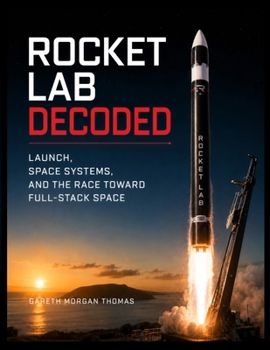
Rocket Lab Decoded: Launch, Space Systems, and the Race Toward Full-Stack Space

Rocket Lab is no longer just a rocket company. And if you are still judging it by Electron alone, you are missing the bigger story.
Rocket Lab Decoded: Launch, Space Systems, and the Race Toward Full-Stack Space examines how Rocket Lab is attempting to build something far more ambitious than a successful launch business: an integrated space company capable of designing, manufacturing, launching, and increasingly operating complete space systems.
This is not a corporate history or a superficial tour of rockets.
It is a technical and strategic examination of the engineering, manufacturing, acquisitions, infrastructure, and competitive decisions behind Rocket Lab's expansion across the space value chain.
Inside, you will examine:
- Electron - its carbon-composite architecture, Rutherford electric-pump engines, Kick Stage, production system, launch cadence, and path toward higher-frequency operations.
- HASTE - how Electron's industrial base has been adapted for hypersonic testing and national-security missions.
- Neutron - the reusable medium-lift architecture, Archimedes methalox engine, return-to-launch-site strategy, and distinctive Hungry Hippo captive fairing.
- Space Systems - including spacecraft platforms, Flatellite manufacturing, Gauss electric propulsion, solar power, star trackers, optical payloads, separation systems, and precision mechanisms.
- Strategic acquisitions - and why capabilities in laser communications, robotics, power, propulsion, sensing, and other critical subsystems matter to vertical integration.
- National-security space - including hypersonic testing, missile-tracking architectures, proliferated constellations, and the growing importance of schedule resilience and production sovereignty.
- The full-stack strategy - how control over more interfaces can influence cost, performance, manufacturing throughput, supply-chain resilience, mission integration, and the ability to compete for larger programs.
- Rocket Lab versus SpaceX and Blue Origin - not as a simplistic rocket comparison, but through launch architecture, vertical integration, manufacturing depth, market positioning, and long-term competitive strategy.
The real question is not whether Rocket Lab can build another successful rocket.
The question is whether launch vehicles, spacecraft, components, factories, acquired technologies, mission integration, and recurring services can reinforce one another strongly enough to create a genuine full-stack space company.
That is the question this book sets out to answer.
Rocket Lab Decoded is written for engineers, aerospace professionals, investors, technologists, students, and serious space-industry readers who want to understand the machinery behind the headlines.
If you want to understand where Rocket Lab is going, you need to understand the system it is building.
Customer Reviews
ThriftBooks ® and the ThriftBooks ® logo are registered trademarks of Thrift Books Global, LLC
