


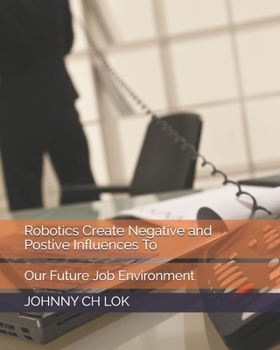
Robotics Create Negative and Postive Influences To: Our Future Job Environment
No Customer Reviews

An office effort measured approach to AIThe real takeaway is that any approach to AI will need to consider the human aspect of every business. AI has great potential to increase efficiency and accuracy and it's already been proven in certain industries. For example, the use of AI In banking to identify and money laundering schemes. It's also improved healthcare by "increasing the speed and accuracy" of cancer diagnosistics. AI can also help reduce the cost and length of human trafficking investigations, a situation where time is precious. In these examples, AI hasn't replaced jobs, but has positively impacted efficiency. Thus, we need to ensure our education system responds to equip young people with the appropriate skills and adaptability, while businesses and public organizations must invest in training. Perhaps most of all, we need to encourage imagination and willingness to experiment. The organizations that can innovate with AI will reap the benefits. Their growth will make them the primary source of future jobs. Companies have a choice when implementing AI. They can choose to effectively implement systems that make employee's lives easier and find creative ways to leverage the technology. It's up to employers to ease fears for workers around AI and build strategies that benefit everyone. Hence, some AI experts believe AI can only raise efficiency to some office tasks, however, AI can not still raise efficiency to all office tasks for any office deparments. The reasons are because some office tasks which can only dominate to finish by human office workers. These office tasks are as below: How can leaders and managers improve employee productivity while still saving time? These below tasks, AI experts ensure that AI can not help any office workers to raise their efficiencies as below:1.Office managers can not delegate to AI to help them to do. While this tip might seem the most obvious, it is often the most difficult to put into practice. We get it-your company is your baby, so you want to have a direct hand in everything that goes on with it. While there is nothing wrong with prioritizing quality (it is what makes a business successful, after all), checking over every small detail yourself rather than delegating can waste everyone's valuable time. Instead, give responsibilities to qualified employees, and trust that they will perform the tasks well. This gives your employees the opportunity to gain skills and leadership experience that will ultimately benefit your company. You hired them for a reason, now give them a chance to prove you right.2.Office managers can not match Tasks to Skills to AI. Knowing your employees' skills and behavioral styles is essential for maximizing efficiency. For example, an extroverted, creative, out-of-the-box thinker is probably a great person to pitch ideas to clients. However, they might struggle if they are given a more rule-intensive, detail-oriented task. Asking your employees to be great at everything just isn't efficient-instead, before giving an employee an assignment, ask yourself: is this the person best suited to perform this task? If not, find someone else whose skills and styles match your needs.3.Office managers can not teach AI to replace them how to communicate and teach their low level staffs how to work effectively. Every manager knows that communication is the key to a productive workforce. Technology has allowed us to contact each other with the mere click of a button (or should we say, tap of a touch screen)-this naturally means that current communication methods are as efficient as possible, right?
Format:Paperback
Language:English
ISBN:B089M59WQD
ISBN13:9798650829959
Release Date:January 1
Publisher:Independently Published
Length:314 Pages
Weight:1.38 lbs.
Dimensions:0.7" x 8.0" x 10.0"
Customer Reviews
0 rating
Copyright © 2025 Thriftbooks.com
Terms of Use | Privacy Policy | Do Not Sell/Share My Personal Information | Cookie Policy | Cookie Preferences | Accessibility Statement
ThriftBooks ® and the ThriftBooks ® logo are registered trademarks of Thrift Books Global, LLC
ThriftBooks ® and the ThriftBooks ® logo are registered trademarks of Thrift Books Global, LLC
