


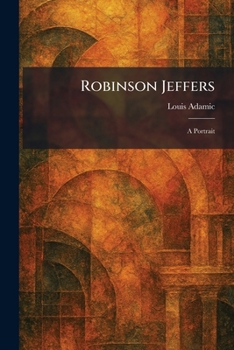
Robinson Jeffers: A Portrait

"Robinson Jeffers: A Portrait" provides an intimate and insightful look at one of the most singular and powerful voices in twentieth-century American poetry. Written by Louis Adamic, this work offers a personal exploration of Jeffers' life and artistic philosophy during a formative period of his career. The narrative captures the essence of the poet's reclusive existence at Tor House in Carmel, California, examining how the rugged Pacific landscape and the elemental forces of nature deeply informed his writing.
Adamic's portrait goes beyond mere biographical facts, delving into the temperament and creative process of a writer known for his tragic themes and the philosophy of inhumanism. By documenting the relationship between the man and his environment, this work provides essential context for understanding the stark, prophetic power of Jeffers' verse. It stands as a vital piece of literary history, offering a contemporary perspective on a figure who challenged the literary conventions of his time and remains a cornerstone of American environmental and philosophical poetry.
This work has been selected by scholars as being culturally important, and is part of the knowledge base of civilization as we know it. This work was reproduced from the original artifact, and remains as true to the original work as possible. Therefore, you may see the original copyright references, library stamps (as most of these works have been housed in our most important libraries around the world), and other notations in the work.
This work is in the public domain in the United States of America, and possibly other nations. Within the United States, you may freely copy and distribute this work, as no entity (individual or corporate) has a copyright on the body of the work.
As a reproduction of a historical artifact, this work may contain missing or blurred pages, poor pictures, errant marks, etc. Scholars believe, and we concur, that this work is important enough to be preserved, reproduced, and made generally available to the public. We appreciate your support of the preservation process, and thank you for being an important part of keeping this knowledge alive and relevant.
Customer Reviews
ThriftBooks ® and the ThriftBooks ® logo are registered trademarks of Thrift Books Global, LLC
