


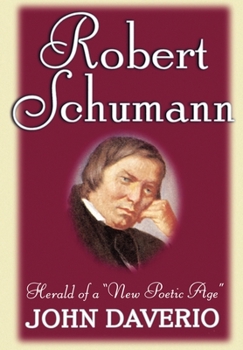
Robert Schumann: Herald of a New Poetic Age

Forced by a hand injury to abandon a career as a pianist, Robert Schumann went on to become one of the world's great composers. Among many works, his Spring Symphony (1841), Piano Concerto in A Minor (1841/1845), and the Third, or Rhenish, Symphony (1850) exemplify his infusion of classical forms with intense, personal emotion. His musical influence continues today and has inspired many other famous composers in the century since his death. Indeed Brahms, in a letter of January 1873, wrote: "The remembrance of Schumann is sacred to me. I will always take this noble pure artist as my model."
Now, in Robert Schumann: Herald of a "New Poetic Age," John Daverio presents the first comprehensive study of the composer's life and works to appear in nearly a century. Long regarded as a quintessentially romantic figure, Schumann also has been portrayed as a profoundly tragic one: a composer who began his career as a genius and ended it as a mere talent. Daverio takes issue with this Schumann myth, arguing instead that the composer's entire creative life was guided by the desire to imbue music with the intellectual substance of literature. A close analysis of the interdependence among Schumann's activities as reader, diarist, critic, and musician reveals the depth of his literary sensibility. Drawing on documents only recently brought to light, the author also provides a fresh outlook on the relationship between Schumann's mental illness--which brought on an extended sanitarium stay and eventual death in 1856--and his musical creativity. Schumann's character as man and artist thus emerges in all its complexity. The book concludes with an analysis of the late works and a postlude on Schumann's influence on successors from Brahms to Berg.
This well-researched study of Schumann interprets the composer's creative legacy in the context of his life and times, combining nineteenth-century cultural and intellectual history with a fascinating analysis of the works themselves.
Now, in Robert Schumann: Herald of a "New Poetic Age," John Daverio presents the first comprehensive study of the composer's life and works to appear in nearly a century. Long regarded as a quintessentially romantic figure, Schumann also has been portrayed as a profoundly tragic one: a composer who began his career as a genius and ended it as a mere talent. Daverio takes issue with this Schumann myth, arguing instead that the composer's entire creative life was guided by the desire to imbue music with the intellectual substance of literature. A close analysis of the interdependence among Schumann's activities as reader, diarist, critic, and musician reveals the depth of his literary sensibility. Drawing on documents only recently brought to light, the author also provides a fresh outlook on the relationship between Schumann's mental illness--which brought on an extended sanitarium stay and eventual death in 1856--and his musical creativity. Schumann's character as man and artist thus emerges in all its complexity. The book concludes with an analysis of the late works and a postlude on Schumann's influence on successors from Brahms to Berg.
This well-researched study of Schumann interprets the composer's creative legacy in the context of his life and times, combining nineteenth-century cultural and intellectual history with a fascinating analysis of the works themselves.
Format:Hardcover
Language:English
ISBN:0195091809
ISBN13:9780195091809
Release Date:April 1997
Publisher:Oxford University Press
Length:624 Pages
Weight:2.34 lbs.
Dimensions:1.8" x 6.5" x 9.6"
Customer Reviews
4 ratings
Splendid
Published by Thriftbooks.com User , 17 years ago
Robert Schumann (b. June 8 1810, d. July 29 1856) Herald of a New Poetic Age, by: John Daverio. Published 1997 by Oxford University Press, Inc. (I bought it on 21 January 2000) Twice I read this book and I must say I enjoyed all the chapters. But was there any LOVE between Clara and Brahms? Was there any intercourse after Robert's gone? I have chosen the following excerpts that are of particular interest to me ............... Forced by a hand injury to abandon a career as a pianist, RS went on to become one of the world's great composers.......... Brahms in a letter of January 1873 wrote ""The remembrance of Schumann is sacred to me. I will always take this noble pure artist as my model"" Antinomy: A contradiction between two statements that seem equally reasonable P 4: ""It is easy to write a Schumann biography because Schumann wrote it himself. It is difficult to write a Schumann biography because the modern biographer must chart the composer's relationships to his complicated and contradictory social surroundings"" Karl Laux. - There is wealth of biographical material -travel notes, diaries maintained with some regularity from January 1827 to early 1854. - Households account books with entries extending from early October 1837 to 23 February 1854 - that is to just four days before Schumann's suicide attempt ... marriage diaries jointly kept by Clara from Sept 1840 P 6 From late March 1833 to July 1836 Schumann did not keep diary. He was an ardent bibliophile - Someone who loves (and usually collects) books. P. 7: Hermeneutic; (Interpretive or explanatory) challenges posed by Schumann's diaries - his works poured forth at the behest of mysterious voices from the beyond ...his works are mosaic-like assembly of fragmentary ideas, suggesting a kind of composition-as-planned-improvisation that finds its sources in his earliest experience at the keyboard. P 8: His family's special repository of letters - the so called Familienkassette - which itself suffered severe water damage as a result of the 1945 bombing of Dresden and survives only because Boetticher had the foresight to microfilm much of the collection at Dresdener Landesbibliothek in 1938. Clara Schumann and Brahms transmitted in the old collected edition- Breitkopf & Hartel 1881-93 - Schumann's thorough engagements with the music. P 9: Literature held a place in Schumann's creative life comparable to that of philosophy in Wagner's. As a youth of 15 read with his friends- particularly all of Schiller's dramas - and as paterfamilias of 43 reread -in some cases for the fourth or fifth time- his favorite Jean Paul novels (Johann Paul Friedrich Richter - 21 March 1763- 14 November 1815) P 10: Schumann's interpretation of life and art in his works - they comingle here more thoroughly than with any other 19th. Century composers - Music as confession- wrote of his favorite author ""In all his works Jean Paul mirrors himself, but always as two persons ......"and as a more mature journali
A Dignified and Knowledgeable Treatment
Published by Thriftbooks.com User , 20 years ago
As other reviewers have said, this is not the biography to read if you want to be titillated by the real or imagined sexual peccadillos of a great master. Instead, this is a critical biography in the best sense. John Daverio's book unfolds Schumann's life with warmth and deep respect for its subject and without undo speculation. Then it goes on to an appreciation of the music whose only failing might be a too-positive appraisal of some works that critics have formerly been cool or even hostile toward. In certain cases, though, Daverio is clearly right. Obviously a well-trained musician, perhaps he can imagine beauties that others have not found through a study of the scores, for many of the works he praises are not available in recorded form--some haven't been heard for ages, I'm sure. This includes, for example, the choral ballads from Schumann's last years. Daverio praises Das Gluck von Edenhall as the finest among them and even argues for its rehabilitation to the repertoire. Knowing Die Sangers Fluch and other examples of Schumann's late choral music, I'm somewhat skeptical. The music in these works is generally four-square and lacking in the orchestral and vocal color the master brought to earlier pieces such as Paradise und die Peri or Requiem fur Mignon. But who can say? Perhaps Das Gluck is an unknown gem that should be taken up again by choral-music groups. The point is that Daverio listens afresh to (or imagines skillfully from the printed score) music that others have dismissed as the work of a genius in decline, and he makes an undeniable point: though Schumann's last works are uneven, they don't represent a thorough collapse of musical powers but in some cases a wholly new approach to musical problems. This is true, say, of the works for violin from the last years, the sonatas and Fantasia. They are unusual even in the context of Schumann's other chamber and concerted works but in no way suggest a diminution of compositional strength. In his appreciation of Schumann's growth as a composer, Daverio reminds me of Joan Chissell, the eminent British Schumann scholar, whose music reviews appeared for years in the Gramophone. I recall that she was constantly revising her estimate upwards for Schumann works each time she actually heard them in recording for the first time, explaining that it was impossible to imagine from the score alone how effective they actually were. Daverio goes even farther out on a critical limb, arguing for the importance of works that haven't been played by anybody for years. And his enthusiasm is infectious, partly because his writing is so good--clean, clear, unaffected, but engaging. Besides, Daverio was clearly right about one work. His book praises Das Paradise und die Peri as a neglected classic of Romanticism. Small wonder, then, that he was chosen to write the notes for John Eliot Gardiner's marvellous recording of the same that appeared on DG a few years ago. And if you haven't heard this recording, do.
Superb scholarship, daring musical analysis
Published by Thriftbooks.com User , 21 years ago
Daverio's biography of Robert Schuman eschews the hackneyed themes familiar to what he terms "psychobiography"--dwelling on the supposed interrelationship between Schumann's idiosyncratic style and his mental collapse following the composition of the marvelous "Gesange der Fruhe." Instead, he offers insight after insight into the originality of Schumann's musical (and literary) genius, especially as they inform what he terms Schumann's uniquely "literary" musical enterprise. A must read for any Schumann devotee.
Top-notch Biography and Analysis
Published by Thriftbooks.com User , 24 years ago
This biography is a superb survey of Schumann's life and works. Those of us who adore Schumann's music have found a great musicologist and champion in John Daverio. His insight into German Romantic music was already made stunningly clear in his previous book on 19th Century music and German Romantic Ideology. Now this book concentrates on the arch-Romantic composer who synthesized the old and the new to create a "New Way" for music. While being deeply analytical when necessary, particularly in regard to the musical works themselves, Daverio writes in a very accessible style which brings his subject quite vividly to life. And Daverio's concluding remarks are timely, beautiful and extremely touching. Just a wonderful book in every respect.
Copyright © 2026 Thriftbooks.com Terms of Use
| Privacy Policy | Do Not
Sell/Share My Personal Information | Cookie Policy | Cookie Preferences | Accessibility Statement
ThriftBooks® and the ThriftBooks® logo are registered trademarks of Thrift Books Global, LLC
ThriftBooks® and the ThriftBooks® logo are registered trademarks of Thrift Books Global, LLC
