


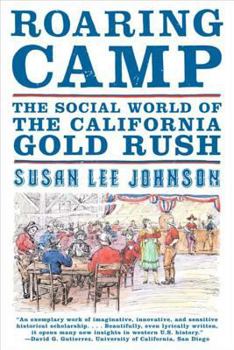
Roaring Camp: The Social World of the California Gold Rush


Select Format
Select Condition 
Book Overview
Historical insight is the alchemy that transforms the familiar story of the Gold Rush into something sparkling and new. The world of the Gold Rush that comes down to us through fiction and film--of unshaven men named Stumpy and Kentuck raising hell and panning for gold--is one of half-truths. In this brilliant work of social history, Susan Johnson enters the well-worked diggings of Gold Rush history and strikes a rich lode. She finds a dynamic social world in which the conventions of identity--ethnic, national, and sexual--were reshaped in surprising ways. She gives us the all-male households of the diggings, the mines where the men worked, and the fandango houses where they played. With a keen eye for character and story, Johnson restores the particular social world that issued in the Gold Rush myths we still cherish.
Format:Paperback
Language:English
ISBN:0393320995
ISBN13:9780393320992
Release Date:December 2000
Publisher:W. W. Norton & Company
Length:466 Pages
Weight:0.98 lbs.
Dimensions:1.2" x 5.5" x 8.3"
Customer Reviews
5 ratings
Wonderful Book
Published by Thriftbooks.com User , 17 years ago
Very well researched book that is fascinating to read. It gives a whole new perspective to life in the gold mines of CA during the mid-1850s.
Four stars for content, one star for book design
Published by Thriftbooks.com User , 18 years ago
Look, the content of this book is awesome and provides a vital link to the history of the gold rush in California! But the book design is terrible, because the paragraph length on average, is about three times normal, and this error in design makes the text quite difficult to read. If you really care about the history of California, you should read Roaring Camp, but it won't be easy, simply due to the overly long paragraph structure. Truth is, this book shows just how much we take good book design and layout, for granted. I'll never do that again, after reading Roaring Camp. How such a supposedly good publisher could allow this kind of flawed paragraph editing to be allowed, that's the real mystery here.
Good book, if you're looking for history
Published by Thriftbooks.com User , 20 years ago
If you're looking for a rip-roaring yarn of hoary old prospectors jumping claims and battling over gold nuggets, this is not it. Johnson's book is a thoughtful work of social history that reexamines the collective memory many people have of the gold rush (all-American gold-diggin' brawl) in the context of the letters, diary entries, legal cases and ballads that people who were actually *in* the gold rush used to document their lives. The picture that emerges is one of a complex society that grew up around the promise of instant wealth. For one thing, Americans were not (in Johnson's account) always the largest group of miners in the Southern mines: French guardsmen expelled by their country, Chilean aristocrats, Mexican families, Canadian traders, Chinese sailors, and the Indian tribes that lived in the area before the gold rush began - everyone got in on the action. This cultural meeting place brought interactions both peaceful (lessons on how to use chopsticks) and violent (the practise of "frontier justice" usually targeted non-whites without caring whether the person hanged had anything to do with the original crime, if in fact an original crime took place.) Johnson's book sketches a believable portrait of the evolvoing politics of the region, and along the way explains everything from the origin of Chinese landromats to Antonio Bandaras's character in _The Mask of Zorro_ (suddenly a much more interesting movie since I read this book). Johnson's writing from a gender-studies perspective, so she's particularly interested in the issues that sprung up in a (mostly) all-male mining society. If you're from a culture that considers women's work "unmanly," and have thus never been taught to cook or clean for yourself, how do you survive in a frontier environment? For some, the answer was you didn't (miners got sick a lot, and scurvy was one of the killers). For others you either learned to practise domestic chores yourself (which you could then sell or split with others), and/or you paid a lot of money for help. In other words, the gold rush not only attracted men after gold, but women who saw they could make money selling services (of all kinds) to the gold miners. Johnson's section on the French prostitutes, for example (who were going to get taxed and inspected for veneral disease if they stayed in France), explains how the real money-makers of the gold rush were often not the miners (who depended on luck to strike it rich) but the merchants who sold to them. The thing I admired the most about this book was the author's voice. Johnson presents us with a bunch of stories, but instead of offering just one interpretation, she gives us many possible readings of stories and also reminds us whose voice is being left out. For example, in her section on miners diaries she reminds the reader that diary-writing was an important part of 19 C Protestantism, so most available diaries are written from a very religious, Protestant perspective. An older his
Paydirt!
Published by Thriftbooks.com User , 25 years ago
There are many good histories of the California Gold Rush, including Malcolm Rohrbough's award-winning _Days of Gold_. But _Roaring Camp_ presents the Gold Rush in a completely new light; and to look at the gold under johnson's illumination is to come to grips with what conventional history (and memory) represses--the intense collisions of cultures and dreams.
Gender, Race, and Sex in California's Gold Rush
Published by Thriftbooks.com User , 25 years ago
Johnson's exquisitely researched and beautifully written book starts with the premise that the Southern mines during the early years of the California Gold Rush (1948-1852) were "a grand field for human interaction and connectedness." They were a kind of experiment in human relations, and Johnson points the spot light on the dynamic and flexible quality of race, gender, and sexuality. She argues that the social world of the gold rush - the organization of domestic labor, the leisure pursuits, and gaming activities (both mining and gambling) - reflected a topsy-turvy world not at all comfortable with itself. Johnson tells a story whereby the gold rush, particularly the relationships that developed in the more diverse and less wealthy Southern mines, created a crisis of racial and gender representation that only sorted itself out with the collusion of Anglo miners and the authority of the state. Johnson notes that Anglo miners, "Conflated their daily lives with a project of national expansion and economic growth infused with notions of progress and 'manifest destiny.'" In this way, Johnson explains the messy and not uncontested work of colonization and racial dominance, and she does so with an eye to the function of gender and sexuality. How was gender inextricably connected to the project of racial dominance? How did sex and sexuality play into the social world miners created for themselves in the early years of the Gold Rush? Through careful research and thoughtful analysis, Johnson sheds light on how, in the gold mines, men were motivated by complex desires - desires that at once explain the role California's Gold Rush played in the American drama of western expansion and colonization. But Johnson also describes the desires that play in and around a heretofore untold history of sex and sexuality in the California gold mines. Johnson's work, as a result, adds significantly to the history of race, gender, and sexuality in the West.
Copyright © 2025 Thriftbooks.com
Terms of Use | Privacy Policy | Do Not Sell/Share My Personal Information | Cookie Policy | Cookie Preferences | Accessibility Statement
ThriftBooks ® and the ThriftBooks ® logo are registered trademarks of Thrift Books Global, LLC
ThriftBooks ® and the ThriftBooks ® logo are registered trademarks of Thrift Books Global, LLC
