


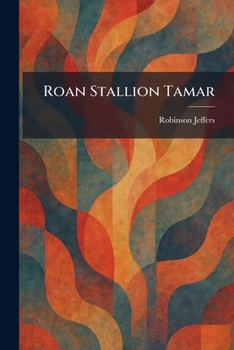
Roan Stallion Tamar

Select Format
Select Condition 
Book Overview
"Roan Stallion Tamar" is a powerful collection of narrative poetry that established Robinson Jeffers as a significant voice in American literature. Set against the rugged, wind-swept backdrop of the California coast, these poems delve into the primal forces of nature and the complexities of human emotion. The work is characterized by its stark, rhythmic lines and a philosophy often described as inhumanism, which emphasizes the majesty of the natural world over the transient preoccupations of humanity.
In the narrative poem "Tamar," the reader encounters a haunting exploration of family, desire, and spiritual isolation, while "Roan Stallion" presents a visceral meditation on power and transcendence through a woman's connection to the titular animal. Jeffers transforms the Big Sur landscape into a mythic stage where the characters struggle with their own impulses against a canvas of indifferent, enduring beauty. This collection remains a cornerstone of 20th-century poetry, offering a dark and sublime vision of the American West. It is an essential read for those interested in modernist verse and the intersection of environmental mysticism with psychological realism.
This work has been selected by scholars as being culturally important, and is part of the knowledge base of civilization as we know it. This work was reproduced from the original artifact, and remains as true to the original work as possible. Therefore, you may see the original copyright references, library stamps (as most of these works have been housed in our most important libraries around the world), and other notations in the work.
This work is in the public domain in the United States of America, and possibly other nations. Within the United States, you may freely copy and distribute this work, as no entity (individual or corporate) has a copyright on the body of the work.
As a reproduction of a historical artifact, this work may contain missing or blurred pages, poor pictures, errant marks, etc. Scholars believe, and we concur, that this work is important enough to be preserved, reproduced, and made generally available to the public. We appreciate your support of the preservation process, and thank you for being an important part of keeping this knowledge alive and relevant.
Related Subjects
PoetryCustomer Reviews
ThriftBooks ® and the ThriftBooks ® logo are registered trademarks of Thrift Books Global, LLC
