


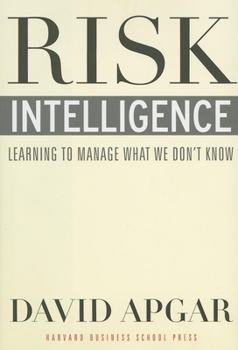
Risk Intelligence: Learning to Manage What We Don't Know

Select Format
Select Condition 
Book Overview
Too many executives think risk management is strictly for technical specialists. In Risk Intelligence: Learning to Manage What We Don't Know, David Apgar challenges this misconception. The author explains how to raise the quality of your risk analysis---thus enhancing your "risk IQ"---by applying four simple rules: 1) Recognize which risks are learnable--and reduce their uncertainty by discovering more about them. 2) Identify risks you can learn about the fastest. The higher your learning speed, the more a project is worth pursuing. 3) Take on risky projects one at a time--learning about the risks underlying each before moving to the next. 4) Build networks of business partners, suppliers, and customers who can collectively manage new ventures' risks by playing distinct roles. The book provides two tools for improving your risk IQ--the Risk Intelligence Audit and the Risk Scorecard--and concludes with a 10-step action plan for systematically raising your managerial and organizational risk IQ. Your reward? Smarter business decisions over time.
Format:Hardcover
Language:English
ISBN:1591399548
ISBN13:9781591399544
Release Date:August 2006
Publisher:Harvard Business Review Press
Length:210 Pages
Weight:1.18 lbs.
Dimensions:0.8" x 6.4" x 9.5"
Customer Reviews
5 ratings
Risky Business
Published by Thriftbooks.com User , 18 years ago
Risk management is a vital function for most rationally managed organizations. Any competent business plan or project proposal will include a section on risk mitigation. So what is risk? In essence it is anything that will hinder or prevent an organization from achieving its goals or purpose. Clearly then it is in an organization's interest to reduce the probability that a risk will occur through what is called `risk mitigation'. There are numerous methodologies to achieve this some good others more problematic. Yet effective risk mitigation can mean the difference between profit or loss and success or failure. It is far from a trivial matter. Which brings us to this rather provocatively titled book, "Risk Intelligence", that provides a unique contribution to risk mitigation. Although Apgar does not say so, he uses the term `intelligence' in both its meanings namely, cognitive ability and processed information. He usefully divides risk into two categories `learnable' and `random' by which he means risks whose probable occurrence can be assessed and risks that may be equally probable but that cannot be assessed accurately. Apgar believes that a number of factors, such as previous experiences, can combine to enable individuals and organizations to understand some risks better than others and that for them such risks are what he calls learnable. He correctly notes that if a specific risk is understood it cannot be predicted, but its probability can be assessed. Such risk `knowledge' can give an organization a competitive edge in most situations. As with so many things once somebody actually thinks them up, the concept of `risk intelligence' seems obvious. But Apgar is to be congratulated for first articulating and explaining such a useful idea. Of course, `risk intelligence' is not the only factor in risk mitigation. Apgar would no doubt be the first to point out that other factors such as reserve capacities, process flexibility, and realistic alternatives provide the resiliency essential to successful risk management.
Risk Intelligence is enthusiastically recommended for business leaders
Published by Thriftbooks.com User , 20 years ago
Written by David Apgar, a managing director of the Corporate Executive Board best-practices research organization which serves senior executives at over 2,500 institutions worldwide, Risk Intelligence: Learning To Manage What We Don't Know openly challenges the common presumption that risk management and related business judgments is a matter solely for technical specialists. Risk Intelligence teaches the reader how to distinguish learnable risks from random risks in business decisions, how to score one's own risk intelligence, how to conduct a solid risk strategy audit, how to build networks that can adapt dynamically to risk, and much more. Written in plain terms with clear examples, Risk Intelligence is enthusiastically recommended for business leaders seeking to sharpen their flexibility and adaptability when confronting unknown threats.
Highly recommended
Published by Thriftbooks.com User , 20 years ago
Apgar's focus on learnable risks offers some very useful frameworks for applying risk management concepts to a real-word competitive business environment.
Excellent new perspective on risk
Published by Thriftbooks.com User , 20 years ago
This is a fantastic book with powerful insight about the failing of portfolio theory when it comes to understanding and managing business risks. Apgar offers wonderful examples to illustrate how business risks are actually learnable and he creates a framework for preparing yourself to be good at learning about and mitigating risk. This would be a very good book for seminars on risk management at the college level or in exec education programs at corporations.
Risk Intelligence is A Category Starter
Published by Thriftbooks.com User , 20 years ago
This is a "must-read" book. It's a category starter. It's full of innovative ideas. It's entertainingly written, and it has great case studies. The category the book starts is the category of risk intelligence, in the sense of one's capability to learn about the risks one will face in an area of endeavor and so cope with and reduce them. In the past, risk intellgence hasn't really referred to intelligence in the sense of the capability to learn about risks. Instead, it's been about a category of business intelligence, which generally refers to information of better quality than ordinary information. So this slight shift in orientation opens up an entirely new and important field, one that can emphasize anew the practical importance of the capacity for organizations and people to learn. This book also provides innovative ideas in every Chapter. In Chapter 1 the idea of relative risk intelligence, or the gap between self and others in ability to learn about risk, is introduced and we are given a set of four myths about risks, and four accompanying rules countering the myths. The distinction between random and learnable risks is also introduced, and definitions of risk and risk intelligence are provided. With this as background, Chapter 2 then discusses the difference between random and learnable risks in order to help readers learn how to distinguish them, and expands a bit on the idea of relative risk intelligence. The chapter ends by emphasizing the need for a way of comparatively scoring risk intelligence. Chapter 3, the pivotal chapter of the book, then immediately turns to filling that need. It offers a method of measuring one's relative "Risk IQ" through a simple test based on five elements focusing on experiences in the risk area in question. The five elements of the test focus on the frequency, relevance, impact, unexpectedness, and diversity of one's experiences, and on the extent to which one is methodical about tracking what one learns. Someone doing the assessment compares organizations, or other actors, on each of the five elements using a simple scaling method. The scores on each element are then summed to get the relative risk IQ score. The score is then used to triage risks, diagnose one's risk intelligence, and classify oneself or one's organization as a risk assessor. The chapter then illustrates classification by using the At & T case, while introducing three patterns of risk assessor: encyclopedists, impressionists, and amnesiacs. The chapter then uses these patterns to develop some ideas about the life cycle of risk assessment skills in organizations, how teams can be used to enhance risk intelligence, how risk intelligence scores value information (involving use of a Bayesian approach), and about relevance as the missing link between information and learning. Having offered a basic tool to assess risk intelligence, in Chapter 4, the book turns to risk strategy auditing, risk strategy, and "pipelines of learning challeng
Copyright © 2026 Thriftbooks.com
Terms of Use | Privacy Policy | Do Not Sell/Share My Personal Information | Cookie Notice | Cookie Preferences | Accessibility Statement
ThriftBooks ® and the ThriftBooks ® logo are registered trademarks of Thrift Books Global, LLC
ThriftBooks ® and the ThriftBooks ® logo are registered trademarks of Thrift Books Global, LLC
