


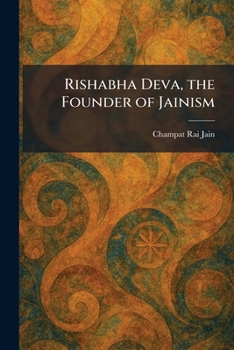
Rishabha Deva, the Founder of Jainism

Select Format
Select Condition 
Book Overview
"Ris?abha Deva, the Founder of Jainism" is an illuminating scholarly exploration into the life and spiritual legacy of the first Tirthankara of Jainism. Written by Champat Rai Jain, this work delves deep into the ancient roots of the Jain tradition, seeking to establish the historical and theological significance of Lord Ris?abha Deva within the broader context of Indian religious history. The text examines the core principles of Jainism, focusing on the path of asceticism, non-violence, and the realization of the soul's true nature as exemplified by its founder.
Through careful analysis of scriptural evidence and philosophical doctrines, the author presents Ris?abha Deva not merely as a mythical figure, but as a pivotal spiritual reformer whose teachings laid the foundation for one of the world's oldest surviving religions. The book covers essential topics such as the nature of the cosmos, the mechanics of karma, and the ultimate goal of liberation (Moksha). By tracing the transition from the primitive ages to the dawn of civilization under Ris?abha Deva's guidance, this work offers profound insights into the evolution of ethical thought and spiritual practice in ancient India. It serves as an essential resource for students of Eastern philosophy and those interested in the foundational figures of world religions.
This work has been selected by scholars as being culturally important, and is part of the knowledge base of civilization as we know it. This work was reproduced from the original artifact, and remains as true to the original work as possible. Therefore, you may see the original copyright references, library stamps (as most of these works have been housed in our most important libraries around the world), and other notations in the work.
This work is in the public domain in the United States of America, and possibly other nations. Within the United States, you may freely copy and distribute this work, as no entity (individual or corporate) has a copyright on the body of the work.
As a reproduction of a historical artifact, this work may contain missing or blurred pages, poor pictures, errant marks, etc. Scholars believe, and we concur, that this work is important enough to be preserved, reproduced, and made generally available to the public. We appreciate your support of the preservation process, and thank you for being an important part of keeping this knowledge alive and relevant.
Customer Reviews
ThriftBooks ® and the ThriftBooks ® logo are registered trademarks of Thrift Books Global, LLC
