


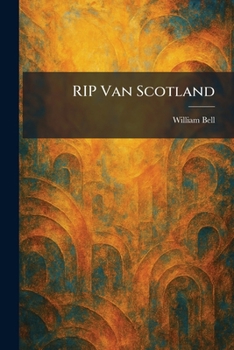
RIP Van Scotland

"RIP Van Scotland" is a provocative and insightful examination of the national identity and political consciousness of Scotland during the early twentieth century. Written by William Bell, this work serves as a clarion call to a nation the author perceives as languishing in a state of political and cultural lethargy, much like the legendary character from whom the book draws its title.
Bell delves into the socio-political landscape of the 1930s, offering a critical analysis of Scotland's position within the United Kingdom. Through a series of reasoned arguments, the text explores themes of nationalism, economic self-sufficiency, and the preservation of distinct Scottish traditions. The author challenges his readers to reconsider the future of their country, advocating for a renewed sense of purpose and self-governance. William Bell provides a historical snapshot of the burgeoning movements that would eventually shape modern Scottish politics.
As a significant piece of political literature, "RIP Van Scotland" remains an essential read for those interested in the history of British politics, the evolution of nationalist sentiment, and the enduring quest for regional identity. This work captures the intellectual fervor of a pivotal era and continues to offer valuable context for understanding the complexities of the Scottish national spirit.
This work has been selected by scholars as being culturally important, and is part of the knowledge base of civilization as we know it. This work was reproduced from the original artifact, and remains as true to the original work as possible. Therefore, you may see the original copyright references, library stamps (as most of these works have been housed in our most important libraries around the world), and other notations in the work.
This work is in the public domain in the United States of America, and possibly other nations. Within the United States, you may freely copy and distribute this work, as no entity (individual or corporate) has a copyright on the body of the work.
As a reproduction of a historical artifact, this work may contain missing or blurred pages, poor pictures, errant marks, etc. Scholars believe, and we concur, that this work is important enough to be preserved, reproduced, and made generally available to the public. We appreciate your support of the preservation process, and thank you for being an important part of keeping this knowledge alive and relevant.
Customer Reviews
ThriftBooks ® and the ThriftBooks ® logo are registered trademarks of Thrift Books Global, LLC
