


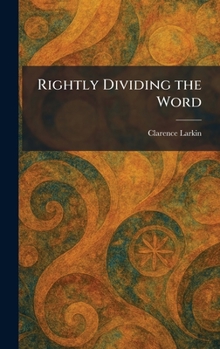
Rightly Dividing the Word


Select Format
Select Condition 
Book Overview
"Rightly Dividing the Word" is a foundational treatise on the principles of dispensationalism and biblical hermeneutics. In this comprehensive work, Clarence Larkin presents a systematic approach to understanding the Holy Scriptures by "rightly dividing" the various ages, dispensations, and covenants described throughout the biblical text. Larkin, a renowned scholar of prophecy and biblical structure, provides a roadmap for students of the Bible to navigate complex theological themes through a lens of literal interpretation and meticulous categorization.
The work aims to clarify the distinctions between the Jews, the Gentiles, and the Church of God, exploring pivotal topics such as the two comings of Christ, the different judgments, and the progressive nature of divine revelation. By organizing the Bible into its constituent parts, the author seeks to resolve apparent contradictions and provide a clear, chronological unfolding of the divine plan. This volume remains a significant resource for those seeking a structured interpretation of biblical prophecy. Its instructional tone and thematic depth make it an essential guide for pastors, students, and anyone interested in the traditional dispensationalist perspective and the historical development of early 20th-century evangelical thought.
This work has been selected by scholars as being culturally important, and is part of the knowledge base of civilization as we know it. This work was reproduced from the original artifact, and remains as true to the original work as possible. Therefore, you may see the original copyright references, library stamps (as most of these works have been housed in our most important libraries around the world), and other notations in the work.
This work is in the public domain in the United States of America, and possibly other nations. Within the United States, you may freely copy and distribute this work, as no entity (individual or corporate) has a copyright on the body of the work.
As a reproduction of a historical artifact, this work may contain missing or blurred pages, poor pictures, errant marks, etc. Scholars believe, and we concur, that this work is important enough to be preserved, reproduced, and made generally available to the public. We appreciate your support of the preservation process, and thank you for being an important part of keeping this knowledge alive and relevant.
Customer Reviews
ThriftBooks ® and the ThriftBooks ® logo are registered trademarks of Thrift Books Global, LLC
