


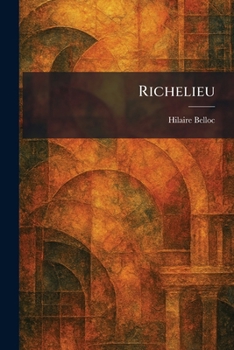
Richelieu

Select Format
Select Condition 
Book Overview
In "Richelieu", acclaimed historian and author Hilaire Belloc provides a masterful examination of the life and political legacy of Armand Jean du Plessis, Cardinal-Duke of Richelieu. As one of the most influential figures in French history, Richelieu served as the chief minister to King Louis XIII, fundamentally transforming the landscape of European politics and the structure of the French state.
Belloc explores the Cardinal's dual role as a prince of the Church and a shrewd statesman, detailing his tireless efforts to consolidate royal power and suppress domestic opposition. The work delves into the complexities of the Thirty Years' War, illustrating how Richelieu's diplomatic maneuvers and military strategies aimed to establish French supremacy while curbing the influence of the Habsburg dynasty. Written with Belloc's characteristic narrative flair and intellectual depth, "Richelieu" offers a profound look at the man who paved the way for the absolute monarchy of Louis XIV and the rise of the modern nation-state.
This biography is more than a mere chronicle of events; it is a penetrating study of power, religion, and the shifting tides of the 17th century. Readers will gain deep insight into the character of a man who navigated the treacherous waters of court intrigue to reshape the map of Europe.
This work has been selected by scholars as being culturally important, and is part of the knowledge base of civilization as we know it. This work was reproduced from the original artifact, and remains as true to the original work as possible. Therefore, you may see the original copyright references, library stamps (as most of these works have been housed in our most important libraries around the world), and other notations in the work.
This work is in the public domain in the United States of America, and possibly other nations. Within the United States, you may freely copy and distribute this work, as no entity (individual or corporate) has a copyright on the body of the work.
As a reproduction of a historical artifact, this work may contain missing or blurred pages, poor pictures, errant marks, etc. Scholars believe, and we concur, that this work is important enough to be preserved, reproduced, and made generally available to the public. We appreciate your support of the preservation process, and thank you for being an important part of keeping this knowledge alive and relevant.
Customer Reviews
ThriftBooks ® and the ThriftBooks ® logo are registered trademarks of Thrift Books Global, LLC
