


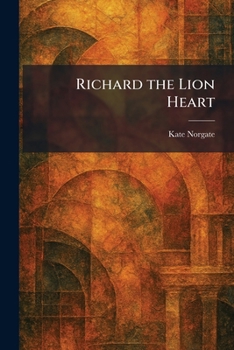
Richard the Lion Heart

"Richard the Lion Heart" is a comprehensive historical biography examining the life and reign of one of England's most iconic monarchs, King Richard I. Written by acclaimed historian Kate Norgate, this work delves into the complex character of the man known as Coeur de Lion, tracing his path from his youth in Aquitaine to his celebrated exploits during the Third Crusade. Norgate meticulously reconstructs the political and military landscape of the late 12th century, offering a detailed analysis of Richard's relationships with his father, Henry II, his mother, Eleanor of Aquitaine, and his rival, Philip Augustus of France.
The narrative provides an in-depth look at the strategic brilliance and chivalric ideals that defined Richard's reputation, while also addressing his administrative role within the Angevin Empire. As a scholarly yet accessible study, "Richard the Lion Heart" remains a vital resource for understanding the medieval English monarchy, the complexities of feudal loyalty, and the enduring legend of the Crusader King. This work stands as a testament to Norgate's expertise in Angevin history, providing readers with a vivid portrait of a ruler whose legacy continues to captivate the historical imagination.
This work has been selected by scholars as being culturally important, and is part of the knowledge base of civilization as we know it. This work was reproduced from the original artifact, and remains as true to the original work as possible. Therefore, you may see the original copyright references, library stamps (as most of these works have been housed in our most important libraries around the world), and other notations in the work.
This work is in the public domain in the United States of America, and possibly other nations. Within the United States, you may freely copy and distribute this work, as no entity (individual or corporate) has a copyright on the body of the work.
As a reproduction of a historical artifact, this work may contain missing or blurred pages, poor pictures, errant marks, etc. Scholars believe, and we concur, that this work is important enough to be preserved, reproduced, and made generally available to the public. We appreciate your support of the preservation process, and thank you for being an important part of keeping this knowledge alive and relevant.
Customer Reviews
ThriftBooks ® and the ThriftBooks ® logo are registered trademarks of Thrift Books Global, LLC
