


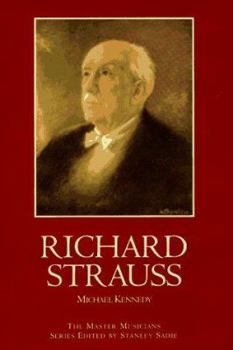
Richard Strauss (Master Musicians Series)

Select Format
Select Condition 
Book Overview
In a career that stretched from the age of Wagner to the middle of the 20th century, Richard Strauss wrote operas and symphonic poems that kept alive the German Romantic ideals of melody and emotional drama in music. Best known as the composer of Der Rosenkavalier and other operas, Strauss also wrote many symphonic works, including such repertory staples as Death and Transfiguration, Don Juan, and Also sprach Zarathustra source of the famous sunrise music used in the film 2001. This book provides an appreciation of Strauss's music as well as an assessment of his life, including his controversial relationship with the Nazi regime.
Format:Hardcover
Language:English
ISBN:0028645170
ISBN13:9780028645179
Release Date:January 1996
Publisher:Schirmer Reference
Length:237 Pages
Weight:1.40 lbs.
Dimensions:9.5" x 1.0" x 6.5"
Customer Reviews
4 ratings
A VERY WORTHWHILE BIOGRAPHY OF A PUZZLING COMPOSER
Published by Thriftbooks.com User , 16 years ago
Michael Kennedy has written a very useful and insightful biography of a controversial composer, along with an ingtelligent analysis of his music. Strauss summarized his approach to "program music" (of which he was a foremost developer) by saying, "I am a musician first and last, for whom all 'programs' are merely the stimulus to the creation of new forms, and nothing more." Kennedy observes that "Religion played no part in his upbringing." By 1892, "he had read Nietzsche's works and had been particularly attracted by 'his polemic against Christianity.'" As Strauss's character Guntram said, "My God speaks to me through myself." It is not surprising, therefore, that Strauss would attempt to set Nietzsche's "Thus Sprach Zarathustra" to music. Controversial not only for writing operas such as "Salome," "(T)he German press denounced him for conducting two afternoon concerts in a New York department store (in 1904) ... Such conduct was 'a prostitution of art.' Strauss replied that the concerts had been given in artistic conditions and, anyway, it was no disgrace to earn money." Kennedy notes that "Strauss's output, large though it was, diminished between 1916 and about 1940 ... No wonder the world of music regarded him by then as almost a fossil." Of course, Strauss's most controversial actions concern with the Nazi Party came to power. For example, in 1933 Joseph Goebbels appointed Strauss to the post of President of the State Music Bureau. Kennedy explains this thusly: "It was not only that Strauss believed nothing was more important than art: he simply did not recognize the conflict, a symptom of a blinkered mentality as a court composer. He kept his nose in the score and ignored the raised voices in the next room." But Strauss was not by any stretch an anti-Semite: "He acknowledged the help and inspiration he had received from Jews, adding that his own most malicious enemies had been Aryans." Kennedy gives a summation: "If his music lacks mystical and spiritual depth---and it does, except for one late work---it has worldly, human rapture and insight, realism, and humor." Kennedy's fine biography is well-worth reading for anyone who wants to know more about the man or his music.
For Strauss enthusiasts
Published by Thriftbooks.com User , 17 years ago
It is an excellent biography of Richard Strauss, well written and employing up-to-date scholarship on the great composer. It portrays not only Strauss' life and historical milieu, but also addresses inaccurate views of his political situation during Hitler's Third Reich, which have unfairly colored his reputation. The book would be an essential tool in fully understanding and appreciating this musical genius.
An eye and ear opener - why did it take this long?
Published by Thriftbooks.com User , 23 years ago
I have grown up reading Michael Kennedy's biographies of such great English composers as Vaughan-Williams and Edward Elgar. So I eagerly picked-up his latest biography of Richard Strauss partly because of what I deemed to be Kennedy's objective approach to his subjects, and also because Strauss seemed to be a deeply held secret not meant to be shared with us ordinary listeners (in other words, there wasn't much else available). Kennedy seems to have slightly more passion for Strauss it turns out than for RVW or Elgar, or at least enough moxy to blow the cover off some well established sacred cows. I know that I was not expecting to read exactly what I read.If you are even vaguely interested in the music of Strauss or even if you are simply intereted in the history of Germany from 1900 to 1950, then this is a very interesting read.Very well done!
The best compact introduction to Richard Strauss
Published by Thriftbooks.com User , 27 years ago
Studies of Richard Strauss have a tendency to hover between enthusiasm and mealy-mouthed criticism. Or else they are so voluminous (multiple volumes) that only the most serious scholar or eager enthusiast can imagine plowing through them. Michael Kennedy's volume has two great strengths that place it at the top of the class when it comes to finding a good introduction to Strauss: It is compact, yet invitingly enthusiastic. Kennedy has the knack of highlighting precisely the unique strengths of each different work. Perhaps this is not so rare when he speaks of the leading masterpieces that others praise as well. But it is his special gift that he makes the reader want to listen to those works that have not been blessed with extreme popularity. All of them offer something that sounds interesting and inviting to the music-lover. Not only is it a superb guide to Richard Strauss; I think this book is a veritable model for the way that the non-technical music lover should be introduced to an important composer.
Copyright © 2026 Thriftbooks.com Terms of Use
| Privacy Policy | Do Not
Sell/Share My Personal Information | Cookie Policy | Cookie Preferences | Accessibility Statement
ThriftBooks® and the ThriftBooks® logo are registered trademarks of Thrift Books Global, LLC
ThriftBooks® and the ThriftBooks® logo are registered trademarks of Thrift Books Global, LLC
