


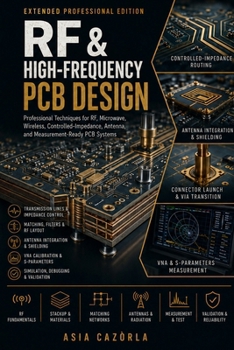
RF & High-Frequency PCB Design: Practical Guide to Radio Frequency and Microwave PCB Engineering (Extended)

RF & High-Frequency PCB Design - Extended Professional Edition is a substantially expanded professional reference for engineers designing RF, microwave, wireless, controlled-impedance, antenna, and measurement-ready PCB systems.
This edition goes beyond a conventional introduction to RF layout. It develops the subject into a complete engineering workflow connecting electromagnetic behavior, circuit intent, material selection, stackup definition, physical implementation, manufacturing, simulation, measurement, debugging, and production release.
At RF and microwave frequencies, PCB traces cannot be treated as simple electrical connections. They behave as distributed transmission structures whose impedance, loss, phase delay, reference planes, discontinuities, vias, connectors, materials, and mechanical environment directly affect performance.
This extended edition explains not only what to do, but why each physical decision matters, how it should be verified, and how the hardware should be prepared for repeatable manufacturing and laboratory validation.
Inside this book, you will learn:
- Why RF PCB design differs from conventional layout
- Frequency, wavelength, phase, propagation, and electrical length
- Transmission-line theory and controlled-impedance design
- Microstrip, stripline, coplanar waveguide, and GCPW
- RF laminates, dielectric behavior, loss tangent, and copper roughness
- Conductor, dielectric, radiation, mismatch, and discontinuity losses
- Lumped and distributed impedance-matching techniques
- Practical Smith chart workflows
- RF component parasitics, Q, ESR, ESL, and self-resonance
- Component placement, partitioning, routing, and isolation
- Grounding, return-current continuity, via fencing, and field containment
- Filters, diplexers, coupled structures, and stopband isolation
- Layout of LNAs, mixers, VCOs, PLLs, synthesizers, and power amplifiers
- PA matching, efficiency, thermal design, linearity, and stability
- PCB antenna integration, tuning, efficiency, and enclosure interaction
- S-parameters, gain, return loss, phase, group delay, and stability
- VNA calibration, SOLT, TRL, fixtures, port extension, and de-embedding
- Spectrum analysis, noise figure, sensitivity, compression, IP3, and EVM
- Electromagnetic simulation and measurement correlation
- Design for manufacturing, assembly, documentation, review, and release
- A guided professional 2.4 GHz RF module project
- RF PCB failure case studies and a complete design-review checklist
The book follows the sequence used in professional RF hardware development: requirements, frequency planning, stackup selection, partitioning, matching, filtering, layout, power integrity, antenna integration, electromagnetic verification, fabrication, assembly, calibration, measurement, troubleshooting, and release.
Who is this book for?- PCB designers moving into RF and microwave systems
- RF, microwave, wireless, radar, IoT, and Satcom engineers
- Embedded engineers integrating RF modules and antennas
- Advanced electronics and electrical-engineering students
Rather than presenting RF design as a collection of isolated rules, this book develops the engineering judgment required to understand how geometry, materials, parasitics, manufacturing variation, return paths, connectors, enclosures, and measurement reference planes determine final system behavior.
Control the impedance. Manage the fields. Minimize the losses. Validate the hardware.
RF & High-Frequency PCB Design - Extended Professional Edition is part of the PCB Engineering Master Series, covering the PCB journey from fundamentals and layout to stackup engineering, signal integrity, EMC, RF, power electronics, manufacturing, reliability, and advanced applications.
Customer Reviews
ThriftBooks ® and the ThriftBooks ® logo are registered trademarks of Thrift Books Global, LLC
