


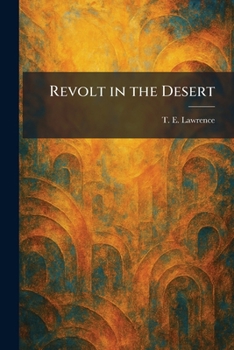
Revolt in the Desert

"Revolt in the Desert" is a gripping firsthand account of the Arab Revolt during the First World War, authored by the legendary T.E. Lawrence. This narrative provides a focused look at the military campaigns and diplomatic efforts led by Lawrence alongside the Arab forces against the Ottoman Empire. Distilled from his larger work, "Seven Pillars of Wisdom", this book highlights the most intense moments of the desert war, offering a streamlined perspective on one of the most significant conflicts of the early 20th century.
The work details Lawrence's experiences as he navigated the complex social and political landscape of the Arabian Peninsula. From the strategic sabotage of the Hejaz Railway to the final push toward Damascus, the text captures the physical and psychological toll of guerrilla warfare in a harsh, unforgiving environment. Lawrence provides vivid descriptions of the desert landscape and the diverse tribes that united under the banner of independence.
As a historical and literary document, "Revolt in the Desert" remains an essential resource for understanding the geopolitical shifts that followed the Great War. It stands as a testament to Lawrence's unique role as both a soldier and a scholar, providing deep insights into the challenges of cross-cultural leadership and the complexities of Middle Eastern history.
This work has been selected by scholars as being culturally important, and is part of the knowledge base of civilization as we know it. This work was reproduced from the original artifact, and remains as true to the original work as possible. Therefore, you may see the original copyright references, library stamps (as most of these works have been housed in our most important libraries around the world), and other notations in the work.
This work is in the public domain in the United States of America, and possibly other nations. Within the United States, you may freely copy and distribute this work, as no entity (individual or corporate) has a copyright on the body of the work.
As a reproduction of a historical artifact, this work may contain missing or blurred pages, poor pictures, errant marks, etc. Scholars believe, and we concur, that this work is important enough to be preserved, reproduced, and made generally available to the public. We appreciate your support of the preservation process, and thank you for being an important part of keeping this knowledge alive and relevant.
Customer Reviews
ThriftBooks ® and the ThriftBooks ® logo are registered trademarks of Thrift Books Global, LLC
