


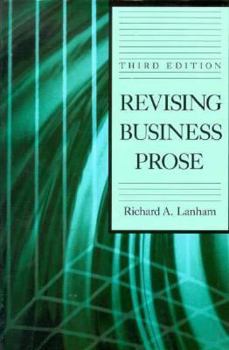
Revising Business Prose


Select Format
Select Condition 
Book Overview
As its title implies, this book deals with revising, not with original composition. In business writing, where a first draft often emerges quickly under the pressures of facts, figures, and deadlines,... This description may be from another edition of this product.
Format:Paperback
Language:English
ISBN:0023674652
ISBN13:9780023674655
Release Date:January 1991
Publisher:Macmillan Coll Div
Length:144 Pages
Weight:0.46 lbs.
Dimensions:8.5" x 5.5" x 0.3"
Customer Reviews
5 ratings
Great but overpriced
Published by Thriftbooks.com User , 17 years ago
Two things taught me to write: this book and reading a lot of CS Lewis. Both will give you a lesson in the key to good communication -- verbs. Most technical reports use a form of "to be" as the verb in almost every sentence. Stop it!
Business writing revision made simple.
Published by Thriftbooks.com User , 19 years ago
This great little book is an island of hope in a world flooded with pompous, pretentious messages. If you practice what Dr. Lanham preaches you will write leaner and tighter texts. You will use his smart paramedic method to get rid of unwanted lard. Just one wish for future editions: Please include some practical exercises. This will help less experienced readers not only gain but retain better writing skills.
Good Focus, Good Examples, Will Improve Your Writing
Published by Thriftbooks.com User , 21 years ago
There are two kinds of bad English: one is the bureaucratic bad English, using 100 words where 10 will do, and the other kind is the one I have suffered from for decades, complex layering of convoluted ideas with too many commas and semi-colons, and too few periods. In a word, undisciplined.This book will help both kinds of English. It is short, to the point, and after reading and practicing what this book preaches, you should be able to cut your confusion of words in half, and increase your clarity and communications value by 100%
Plain English for the business writer
Published by Thriftbooks.com User , 23 years ago
For years, Professor Lanham has been after us about wordiness. He calls it the Official Style; it's practiced whenever writers want to sound important, and to achieve this effect inflate what they write like Macy's Parade balloons. His "Paramedic Method" of rescuing hyper-inflated prose is directed in this slender volume to writers of business communications: memos, reports, policies, procedures, you name it. By following his advice step by step, it's possible to achieve directness, clarity, even simplicity by finding the plain English that neatly expresses what we want to say. And that means finding and disposing of all the unnecessary verbiage, which by Lanham's estimate comprises about 50% of what we write.Take the following cumbersome sentence, the likes of which routinely typify everyday business communications: "On the basis of the answers to these and other questions which the team might ask, I would expect the team to present us with detailed recomendations for enhancing the effectiveness of our reporting." Lanham shows how to transform it into something elegantly precise: "By answering questions like these, the team should be able to recommend improvements in our reporting." A reduction, he would be quick to point out, from 34 words to 16 words. True, as the saying goes, it takes longer to write something shorter, but the finished product is more likely to be read, understood, and acted upon by its intended audience.Lanham's approach to all this is hardly stuffy. He has a good time poking fun at egregious examples of ponderous prose, and he also has a good time whacking it into something presentable. And the end result isn't just readable; it's alive, full of energy, and packs a wallop. This book is for every business person who has something important to say and wants to be sure that what they've written gets read rather than shoved to the side because it's a chore to plow through. Buy this book, read it, and reread it. You won't be sorry.
Excellent for those revising for Clarity
Published by Thriftbooks.com User , 23 years ago
I was given an earlier edition of this book by a colleague in the English department. I laughed when I thought this little David was going to tackle the Goliath of Business prose, but darned if he didn't come through like a crackshot. Lanham effectively teaches writers who hide their ideas in complicated and wordy prose how to cut through the fog and reveal their ideas. Sometimes--and no offense to university teachers (heck I'm one of them) students get it into their heads that convolution leads to respect--and that may be for those writing books on theory--but most of the time convoluted prose just leads the reader to a lot of head-scratching. If you are writing, you need to be clear. This is especially true if you are writing for business. Lanham helps you dissipate cloudy phrasings, and pull ideas out into the light of day. I had to give my copy back to my colleague, but I'm ordering my own now. (I also shudder to think how my prose in this paragraph would stand up to scrutiny--which is why I'm buying and memorizing the book.) I recommend this for English teachers and those writing for businesses--after all there are lots of assessments, idea-pitching and grant writing that need clarity. Lanham comes through like a hero.
Copyright © 2026 Thriftbooks.com Terms of Use
| Privacy Policy | Do Not
Sell/Share My Personal Information | Cookie Policy | Cookie Preferences | Accessibility Statement
ThriftBooks® and the ThriftBooks® logo are registered trademarks of Thrift Books Global, LLC
ThriftBooks® and the ThriftBooks® logo are registered trademarks of Thrift Books Global, LLC
