


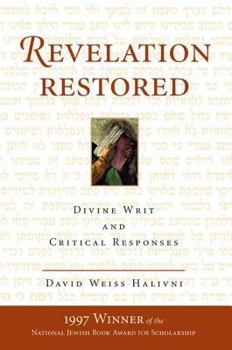
Revelation Restored: Divine Writ And Critical Responses

Select Format
Select Condition 
Book Overview
In this thought-provoking book, David Weiss Halivni asserts that the act of acknowledging and accounting for inconsistencies in the Pentateuchal text is not alien to the Biblical or Rabbinic tradition and need not belie the tradition of revelation
Format:Paperback
Language:English
ISBN:0813333474
ISBN13:9780813333472
Release Date:August 1998
Publisher:Routledge
Length:138 Pages
Weight:0.45 lbs.
Dimensions:0.4" x 6.0" x 9.0"
Customer Reviews
2 ratings
very interesting . . .
Published by Thriftbooks.com User , 23 years ago
for the reasons stated by another reviewer. But this book does beg a few questions. I think Halivni could have gone into more detail about his reasons for believing the Torah's text is imperfect - perhaps by discussing in more depth classical commentators' attempts to explain away those imperfections, and then responding to those attempts. And the entire argument begs a question: if the written Torah is imperfect, how can the oral Torah be any less so?
Ezra Restored the Revelation Given to Moses.
Published by Thriftbooks.com User , 27 years ago
In this fascinating and provocative book, Rabbi Halivni is arguing that although the written Torah -- the Chumash or Pentateuch -- was most probably "compiled" by Ezra and his entourage after the return from the Babylonian exile, it is nonetheless still 'Holy Writ' because the work of Ezra was a successful "restoration" of the Torah given to Moses. Although Halivni probably does not mean that the structure and textual surface of the Chumash closely resembles whatever written Torah crossed the Jordan with Joshua, Halivni does most likely mean that the content of the Chumash reliably expresses the content of the Sinaitic revelation, and contains remnants of whatever writings Moses produced or had produced during the Sinai sojourn.If there is some uncertainty about Halivni's views concerning the superficial similarity of the Chumash with the original written Torah, it is because Halivni's focus is on the evidence for and theological implications of the notion that the present written Torah is the product of a restorative project by Ezra and his entourage. Halivni argues that the very fact that the Chumash contains uncertain passages, self-contradictions, and laws at variance with the Oral Torah, means that the compilers were working with source documents that were already considered so sacred that the compilers felt they could not make any corrections to the text being compiled. They selected and arranged the scriptural heritage, but they dared not correct it or add to it. Their project was to "restore" a unified written Torah from the strands and traditions available to them. They operated more like those who restore damaged paintings, than as painters.Halivni aims to show that traditional Judaism can survive the onslaught of critical scholarship because the probablility that the written Torah is a composite document compiled from strands and traditions doesn't mean that it isn't a trustworthy "restoration" of the Torah given to Moses. If the component strands and traditions were various reliable witnesses to, or remanants of, the original Sinaitic revelation, then a restorative compilation of those trustworthy witnesses renders a written Torah which is Holy Writ. There are many interesting sub-arguments in this book, all insightful, and I highly recommend it to anyone with an interest in Jewish Biblical Criticism or theology of revelation.
Copyright © 2026 Thriftbooks.com
Terms of Use | Privacy Policy | Do Not Sell/Share My Personal Information | Cookie Policy | Cookie Preferences | Accessibility Statement
ThriftBooks ® and the ThriftBooks ® logo are registered trademarks of Thrift Books Global, LLC
ThriftBooks ® and the ThriftBooks ® logo are registered trademarks of Thrift Books Global, LLC
