


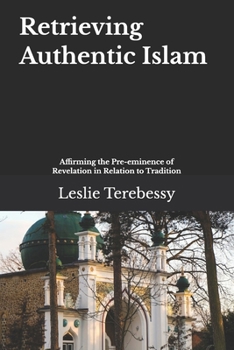
Retrieving Authentic Islam: Affirming the Pre-eminence of Revelation in Relation to Tradition
No Customer Reviews

The umma is experiencing tribulations. For it turned from revelation to tradition. This reoriented the umma from a revelation-centric paradigm to a tradition-centric one. The knowledge of revelation requires rehabilitation. The knowledge of revelation requires rehabilitation because it was corrupted by politics. The corruption was triggered by the weaponization of revelation, expected to further the empire-building efforts of hawkish rulers. Knowledge of revelation was corrupted by perceptions that the Book of Allah is "unclear," "insufficiently detailed," and "contradictory." To "clarify" and "detail" revelation, exegetes turned to tradition. To justify the recourse to tradition, they asserted that tradition is also revelation, a second "revelation." This enabled tradition to become a root of legislation, at times even abrogating and replacing revealed rulings, for example those on apostasy and adultery. But to treat tradition as "equal to" and even a "part of revelation" is to treat traditions as "partners" of the Book of Allah. This is shirk. Moreover, as tradition is not revelation, the re-orientation from revelation to tradition resulted in disorientation. Hearsay reports do not guide better than Allah. The "ascent" of tradition did not stop just at treating tradition as "equal" to revelation. Tradition also became a "judge" and "abrogator" of revelation. But treating tradition as a "judge" of revelation is to subordinate the rulings of God to men. It is to reverse the relationship between God and man. This is also an expression of shirk. In different words, in "traditional" Islam tradition surpassed revelation. Revelation became a "prot g " of tradition. This arrangement, however, reversed the relationship between revelation and tradition. The reversal of the relationship between revelation and tradition places the Book of Allah "under" the "jurisdiction" of tradition. This is reflected in the perceptions that tradition "judges" revelation and that "revelation requires tradition more than tradition requires revelation." The subordination of revelation to tradition was justified by the perception that using reason to understand revelation is kufr. It was also justified by the perception that revelation is in parts "unclear" and "insufficiently detailed." These perceptions contradict revelation. For revelation presents itself as "clear" as well as "fully detailed." It also asks us to use our reason. Revelation is the furqan, the criterion for judgment. These assumptions paved the way for recourse to the teaching of abrogation. According to this teaching, verses revealed earlier were abrogated by allegedly "contradictory" verses revealed afterwards. But this is problematic. For the Book of Allah says that we will never find a change in the words of Allah. The Book also presents itself as internally consistent. Moreover, to ask a person to reject any verse of the Book of Allah is tantamount to asking that person to perpetrate kufr in the allegedly "abrogated" verses. The teaching of abrogation is an invitation to kufr. The teaching of abrogation tainted the knowledge of revelation, especially with the apparent "abrogation" of the verses of reconciliation by the ayah as-sayf. The teaching of abrogation enabled hawkish ulama to transform Islam into a teaching of war. Waging wars to "propagate" Islam through wars of aggression was treated as a sixth pillar of Islam, in a defiance of the prohibition of compulsion in religion. The purported "abrogation" of any verse is tantamount to tampering with revelation. The abrogation of the verses of reconciliation robbed Islam of its teaching of reconciliation. The treatment of tradition as "revelation" marked the emergence of "traditional" Islam. Recourse to the teaching of abrogation marked the emergence of "political" Islam. As regeneration requires knowledge, renewal requires the rehabilitation and re-engagement of reason. For it is in part through reason that we acquire knowledge.
Format:Paperback
Language:English
ISBN:B092XJP3FH
ISBN13:9798740055329
Release Date:April 2021
Publisher:Independently Published
Length:128 Pages
Weight:0.40 lbs.
Dimensions:0.3" x 6.0" x 9.0"
Customer Reviews
0 rating
Copyright © 2026 Thriftbooks.com Terms of Use
| Privacy Policy | Do Not
Sell/Share My Personal Information | Cookie Policy | Cookie Preferences | Accessibility Statement
ThriftBooks® and the ThriftBooks® logo are registered trademarks of Thrift Books Global, LLC
ThriftBooks® and the ThriftBooks® logo are registered trademarks of Thrift Books Global, LLC
