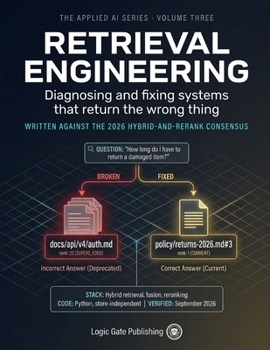
Retrieval Engineering: Diagnosing and fixing systems that return the wrong thing - Written against the 2026 hybrid-and-rerank consensus

Your Retrieval Pipeline Is Fine. It Still Returns the Wrong Thing.
Most books published in the last two years teach you how to build a basic retrieval-augmented generation (RAG) pipeline. This book-Volume Three of The Applied AI Series-teaches you how to fix a working one when it fails.
Retrieval Engineering is a hands-on diagnostic manual for identifying and repairing AI systems that retrieve the wrong documents, bury correct answers in the ranking, or return fluent, confident hallucinations. Written against the 2026 hybrid-and-rerank consensus, this guide replaces endless parameter sweeping with a structured, six-stage diagnostic ladder.
Inside, you will learn how to:
Pinpoint the Six Failure Modes: Determine instantly whether your system is failing at corpus coverage, chunking, retrieval, ranking, assembly, or generation.
Master the Hybrid Consensus: Properly configure BM25 lexical search alongside dense vector embeddings to catch exact identifiers and rare nouns, and combine them correctly using Reciprocal Rank Fusion (RRF).
Implement Cross-Encoder Reranking: Rescue correct answers buried deep in the candidate list and promote them to the top of your shortlist before they hit the context window cut.
Fix "Orphaned" Chunks: Use structural context injection to keep critical metadata (like API versions, section headers, and product names) attached to your data so it actually makes sense to the model.
Handle Query Decomposition: Route identifiers around language models, resolve conversational pronouns, and decompose complex, multi-part user queries without unnecessary overhead.
Measure Staged Recall: Stop relying on end-to-end metrics that summarize failure, and build isolated, conditional metrics that actually localize the fault.
Complete with runnable Python listings, real-world case studies, and store-independent methods, this book from Logic Gate Publishing gives you the exact blueprint to stop guessing and start engineering.
Stop tweaking chunk sizes and hoping for a different result. Get your copy today and fix the real bottleneck in your AI pipeline.
Customer Reviews
ThriftBooks ® and the ThriftBooks ® logo are registered trademarks of Thrift Books Global, LLC