


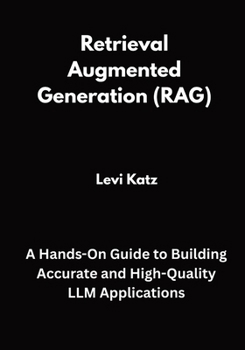
Retrieval Augmented Generation (RAG): A Hands-On Guide to Building Accurate and High-Quality LLM Applications

Large Language Models (LLMs) are extraordinary storytellers - but they sometimes invent facts, overlook crucial context, or struggle with domain-specific knowledge. Retrieval Augmented Generation changes the game by grounding LLMs in real data, enabling them to retrieve relevant information and weave it seamlessly into their output. The result? Faster, more reliable, and context-rich AI systems ready for production.
In this hands-on guide, you'll move far beyond the black box. You'll learn how to build your own RAG pipelines from scratch, understand their inner workings, and fine-tune them for specific real-world use cases. With clear explanations, practical examples, and clean code, this book shows you how to turn theory into deployable solutions.
What You'll LearnMaster the RAG architecture: Learn how information retrieval and text generation work together to deliver superior outputs.
Build robust pipelines: Collect and preprocess high-quality data, generate document embeddings, and fine-tune language models to match your domain.
Implement effective search strategies: Harness keyword and semantic techniques to find the "golden nuggets" your models need.
Fuse retrieval with generation: Blend factual accuracy with the creativity of LLMs using contextual fusion techniques.
Ensure reliability and trust: Integrate fact-checking, contextual filtering, and ranking methods to combat misinformation and bias.
Apply RAG across diverse use cases: From content creation to code generation, personalization, education, and beyond - explore practical applications with step-by-step scenarios.
Why This Book?Hands-on approach: Every chapter includes clear, runnable code examples and real-world scenarios.
Up-to-date techniques: Covers modern RAG workflows, embeddings, fine-tuning, contextual fusion, and multi-modal integration.
Written for practitioners: Whether you're an AI engineer, researcher, data scientist, or developer, this book gives you the tools to go from zero to production-ready RAG systems.
Perfect ForDevelopers who want to make LLMs more accurate and useful in production
Data and ML engineers building retrieval-powered AI systems
Researchers exploring cutting-edge information retrieval and generation methods
Technical teams building domain-specific knowledge systems and RAG-based chatbots
Customer Reviews
ThriftBooks ® and the ThriftBooks ® logo are registered trademarks of Thrift Books Global, LLC
