


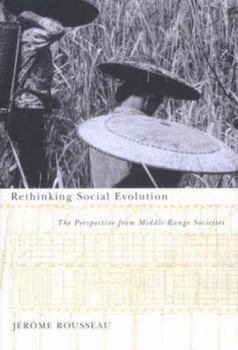
Rethinking Social Evolution: The Perspective from Middle-Range Societies
No Customer Reviews

Select Format
Select Condition 
Book Overview
Human societies are characterized by complex and varied social systems that change through time due to communication and negotiation. J r me Rousseau makes cognitive complexity his starting point in an innovative study of how and why human societies evolve.
The focus of Rousseau's enquiry is "middle-range" societies - a vast category between hunter-gatherers and states. Breaking away from traditional analyses of social evolution as a response to ecological constraints, he shows that social systems are maintained and transformed through self-interest and suggests that conflicts about sharing generate social transformations that result in inequality and increasingly encompassing socio-political structures. Rethinking Social Evolution is a wide-ranging exploration of how language and increased cognitive abilities constitute the motor of social evolution. Drawing on a wide range of ethnographic case studies, Rousseau offers a better understanding of how modern societies are the result of choices by people who both collaborate and compete.Format:Hardcover
Language:English
ISBN:0773531106
ISBN13:9780773531109
Release Date:October 2006
Publisher:McGill-Queen's University Press
Length:304 Pages
Weight:1.23 lbs.
Dimensions:0.7" x 6.0" x 9.0"
Customer Reviews
0 rating
Copyright © 2026 Thriftbooks.com
Terms of Use | Privacy Policy | Do Not Sell/Share My Personal Information | Cookie Policy | Cookie Preferences | Accessibility Statement
ThriftBooks ® and the ThriftBooks ® logo are registered trademarks of Thrift Books Global, LLC
ThriftBooks ® and the ThriftBooks ® logo are registered trademarks of Thrift Books Global, LLC
