


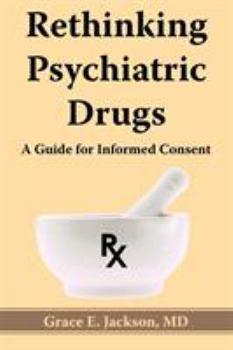
Rethinking Psychiatric Drugs: A Guide for Informed Consent

Select Format
Select Condition 
Book Overview
-- Are patients aware of the fact that pharmacological therapies stress the brain in ways which may prevent or postpone symptomatic and functional recovery ? ==================================================== Rethinking Psychiatric Drugs: A Guide for Informed Consent is a critical appraisal of the medications which an estimated 20% of Americans consume on a regular (and sometimes involuntary) basis. It is the philosophically, epidemiologically, and scientifically supported revelation of how and why psychiatry's drug therapies have contributed to a standard of care which frequently does more to harm than to cure. Extensively researched and documented, the book addresses: -- the process by which psychiatric drugs reach the market -- the history and philosophy of Evidence Based Medicine -- the common flaws in research methodologies which negate the validity of the psychiatric RCT (Randomized Controlled Trial) -- the problem of allostatic load (how drugs stress the body) -- the history, long term effects, and utility of the drugs used to suppress symptoms of depression, psychosis, inattention and hyperactivity -- the effectiveness of alternatives to medication Rethinking Psychiatric Drugs: A Guide for Informed Consent exposes the current crisis in medical ethics and epistemology, and attempts to restore to psychiatry an authentically informed consent to care.
Format:Paperback
Language:English
ISBN:1420867423
ISBN13:9781420867428
Release Date:January 1
Publisher:AuthorHouse
Length:420 Pages
Weight:1.35 lbs.
Dimensions:0.9" x 6.0" x 9.0"
Customer Reviews
5 ratings
An "Owners Manual" for the human mind.
Published by Thriftbooks.com User , 20 years ago
Dr. Grace Jackson has done the human race a great service. She has produced an Owners Manual for the human brain. This book goes far beyond "informed consent". More precisely, this is a "Shop Manual", of the sort normally reserved for the "priesthood" of technicians who work in the "under the hood" innerds of todays highly complex marvels. Because of the deluge of misinformation and disinformation on the human mind one is faced with in everyday life; it is vital to get the straight story. Anything less might produce catastrophic consequences. Dr. Jackson's no nonsense approach demystifies this much-bedeviled topic. This is not light reading. While her book is a meticulously documented and precise treatise written by a professional for professionals; Dr. Jackson provides helpful, brief explanations of the medical terms involved for the lay reader. This book should be standard equipment for every human being. Keep it handy in your "glove compartment". Vince Boehm, Wilmington, DE
Informed Consent
Published by Thriftbooks.com User , 20 years ago
The very best I have read on the subject of psychiatric drugs...Dr. Jackson does not merely describe the effects of the Rx as with most other text on the subject, but actually provides explainations for the effects. It is exceptionally well researched and written and does indeed provide a guide for informed consent. In fact it provides a very sound critque for NOT consenting to psychiatric drugs...Rethinking Psychiatric Drugs should be compulsory reading for all Health Professionals as part of their CME ( continiung medical education). It is written ineasy to understand language without the extreme academic medical jargon incomprehensible to the layman. It is an ideal book for those who have found themeselves having to care for someone who has been labelled as "mentally ill"...and being treated with these mind altering drugs. The book is a revelation that these Rx's do indeed prevent symptomatic recovery...ask any patient in a psychiatric ward.
What The Mental Health System Doesn't Want You To Know
Published by Thriftbooks.com User , 21 years ago
Dr. Grace Jackson has done an excellent job in engaging and capturing the reader's attention beginning with the Prologue and ending with the epilogue... Rethinking Psychiatric Drugs: A Guide for Informed Consent.... as Emeril would say.... BAM!!! Job well done. The structure of the book is well organized; the headings are clearly defined with supporting data, statistics, and content. The size of font and spacing are excellent ... I appreciate that the paragraphs are not lengthy and made for easy reading. The book is a worthy reference manual. literally... each line led me to want to read more. more .. faster and faster.. I did not find myself having to ask, what am I reading? What is this author trying to tell me? Most of chapters are short (7,8,9-are longer chapters), concise, clearly outlined, digestible, revelant, not awkward or overly complicated, and they flow. Beginning with chapters 4 to 9 Dr. Jackson provides a variety of scientific studies, visual aids, tables, and comparison studies, which substantiate the content of her book. I appreciate that Dr. Jackson deciphers and explains the comprehensive data for the non-scientific mind in chapters 4 to 9 As a mental health professional, Rethinking Psychiatric Drugs: A Guide for Informed Consent has now equipped me with some vital information to be a more effective clinician. A hundred thanks you, Dr. Jackson!!!
The Book Could Save Lives
Published by Thriftbooks.com User , 21 years ago
A one-of-a-kind book that does not to presume to say "do or don't". Impeccably researched, it is a must read for anyone interested in the undisclosed facts about many psychiatric medications: namely, how they stress the brain and create life-long patients. Rethinking Psychiatric Drugs: A Guide for Informed Consent is presented succinctly, is easily read and broken down for the layman or professional. Lest the reader lose hope, the book also presents "evidence based" literature which demonstrates the existence of safe and effective alternatives to psychiatric drugs.
Psychiatric Drugs--Mostly Placebos
Published by Thriftbooks.com User , 21 years ago
Very highly recommended. After obtaining data through the Freedom of Information Act from the FDA, Dr. Irving Kirsch did an analysis of the 6 most widely used antidepressant drugs. It found that on average they only have an 18% effect over and above placebo effects. Given the side effects, expense, and withdrawal syndrome, these kinds of findings should cause everyone to reevaluate reliance on medication treatment. There are similar findings with anxiety medications, and shockingly, the average ritalin follow-up study is only 3 weeks long. However, tne multi-billion dollar drug companies have tremendous influence on psychiatry and the FDA. The public must realize that FDA approval for a drug only requires 2 controlled studies showing a statistical significance over a placebo, and there is no limit on how many other studies have been done that found no positive effect. Although medications can certainly play a role in treatment, this book will inform the public and mental health professionals alike on how over-rated medication treatment is.
Copyright © 2026 Thriftbooks.com
Terms of Use | Privacy Policy | Do Not Sell/Share My Personal Information | Cookie Policy | Cookie Preferences | Accessibility Statement
ThriftBooks ® and the ThriftBooks ® logo are registered trademarks of Thrift Books Global, LLC
ThriftBooks ® and the ThriftBooks ® logo are registered trademarks of Thrift Books Global, LLC
